by Tim Gordon
The Star Trek Crews That Turned Starships Into Families
Star Trek Crews have always been the real engines of the Final Frontier.
The captain may sit in the center chair. The first officer may stand ready to challenge or succeed them. But no Enterprise, space station, Voyager, Discovery or other Starfleet vessel survives because of command alone.
Someone has to understand the science.
Someone has to keep the engines running.
Someone has to heal the wounded.
Someone has to defend the ship.
Someone has to navigate through the impossible.
And someone has to understand the people on the other side of the viewscreen.
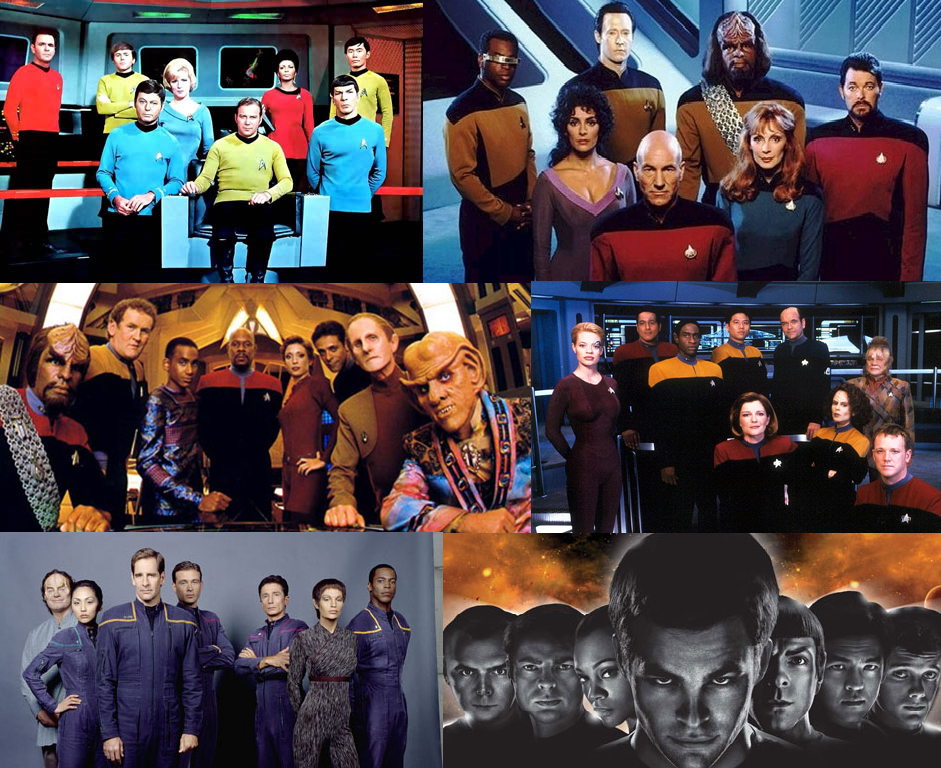
Across sixty years, Star Trek has repeatedly assembled crews whose differences became their greatest strength. Humans worked beside Vulcans, Klingons, Bajorans, Trill, Kelpiens, androids, holograms, former Borg drones and people who once considered Starfleet their enemy.
The technology changed.
The uniforms changed.
The galaxy grew larger.
But the fundamental idea remained.
Nobody explores the future alone.

Science & Logic | Understanding the Unknown
Before Starfleet can survive the unknown, someone has to understand it.
That responsibility has produced some of the franchise’s most memorable characters.
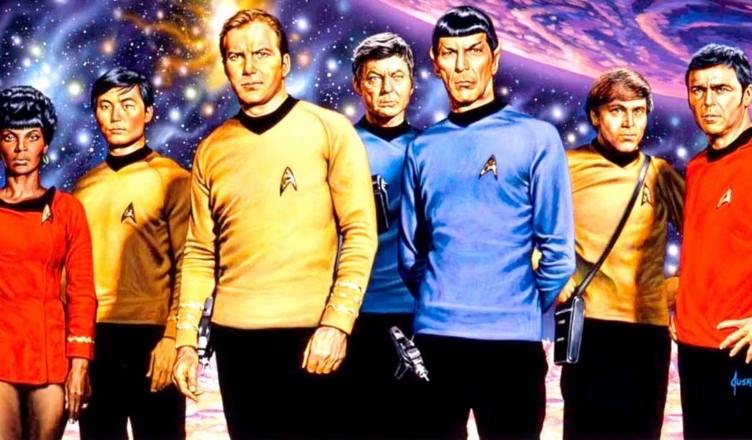
Spock established the archetype.
As science officer aboard the Enterprise, his Vulcan logic provided a counterbalance to Kirk’s instinct and McCoy’s emotion. But Spock’s importance extended far beyond scientific expertise. His very existence, the son of a Vulcan father and human mother, made him a living expression of Star Trek’s belief that seemingly incompatible worlds could find common ground.
Decades later, Data approached humanity from another direction.
The android officer aboard the Enterprise-D could process information at extraordinary speed, but his most compelling questions weren’t scientific.
They were personal.
What does it mean to be human?
Can an artificial being possess rights?
Can curiosity become friendship?
Can intelligence become a person?
Jadzia Dax brought another perspective to Deep Space Nine. As a Trill joined with a centuries-old symbiont, she carried memories and experiences belonging to multiple lifetimes. Her scientific knowledge therefore existed alongside something equally valuable: perspective.
Discovery expanded the tradition through officers such as Paul Stamets, whose expertise in astromycology made the experimental spore drive possible, and Sylvia Tilly, whose curiosity and enthusiasm developed into increasingly confident leadership.
The best scientists among the Star Trek Crews don’t simply explain anomalies.
They remind us that curiosity is one of Starfleet’s defining virtues.
The universe isn’t something to conquer.
It is something to understand.
Engineering | The Miracle Workers
Every starship eventually encounters a problem that should be impossible to fix.
Fortunately, Star Trek has engineers.
Montgomery Scott established the mythology.
Scotty understood the Enterprise at a level that frequently seemed almost personal. Warp cores, transporters, shields and engines weren’t simply machinery under his supervision.
They were his responsibility.
And when Kirk demanded the impossible, Scotty usually found a way to make the impossible slightly less impossible.
Geordi La Forge inherited that tradition aboard the Enterprise-D. His VISOR allowed him to perceive the electromagnetic spectrum beyond ordinary human sight, transforming what others might consider a disability into a different way of experiencing the universe.
Miles O’Brien gave engineering a different texture.
On Deep Space Nine, technology didn’t always cooperate because the station itself was a collision of Cardassian infrastructure and Federation systems. O’Brien wasn’t maintaining Starfleet’s newest flagship.
He was keeping incompatible technologies functioning together while the station became one of the most strategically important locations in the quadrant.
B’Elanna Torres faced another challenge aboard Voyager.
Half-human, half-Klingon and formerly Maquis, Torres carried anger, brilliance and divided identity into engineering. She also had to keep an Intrepid-class starship operational while Voyager remained tens of thousands of light-years from a Starfleet repair facility.
Trip Tucker helped humanity learn how to operate in deep space before many of Starfleet’s later technological assumptions existed.
Jett Reno brought dry pragmatism to Discovery.
Rok-Tahk discovered an unexpected aptitude for science and engineering aboard the Protostar.
The technology changes from generation to generation.
The engineer’s problem doesn’t.
Something is broken.
Everyone may die.
Fix it.
Medicine | Protecting the People Behind the Mission
Starfleet’s mission may be exploration, but exploration has consequences.
Bones McCoy understood that immediately.
As chief medical officer aboard Kirk’s Enterprise, McCoy wasn’t merely responsible for treating injuries. He frequently served as the emotional counterweight to Spock’s logic and Kirk’s command responsibility.
His medical judgment could also place him directly against the captain.
That matters.
A Starfleet doctor isn’t simply another officer in the chain of command. Medical authority carries its own responsibilities, particularly when the captain’s health or judgment becomes compromised.
Beverly Crusher expanded the position aboard the Enterprise-D, combining medicine, science and command experience.
Julian Bashir arrived on Deep Space Nine eager for frontier medicine and discovered considerably more than he anticipated. His journey from an overeager young doctor to a physician confronting war, genetic engineering and the moral compromises of Section 31 became one of the series’ quieter transformations.
Voyager complicated the position completely.
Its chief medical officer died almost immediately.
The replacement was software.
The Emergency Medical Hologram began as a program intended for temporary crises and gradually became one of Voyager’s most complex individuals. He developed interests, friendships, ambitions and questions about whether an artificial intelligence could possess autonomy.
Dr. Phlox brought Denobulan medicine and an entirely different cultural perspective aboard Archer’s Enterprise.
Hugh Culber brought medicine, counseling and his own experience with death and resurrection to Discovery.
Across the Star Trek Crews, doctors repeatedly confront a question hidden underneath every mission:
What is exploration worth if we forget the lives doing the exploring?
Security & Tactical | Defending the Dream
Star Trek imagines an optimistic future.
It has never imagined a harmless one.
Starfleet ventures into territories containing hostile governments, unknown species, spatial phenomena and civilizations whose intentions cannot always be solved through diplomacy.
Someone has to protect the crew.
Pavel Chekov eventually served as security chief aboard the original Enterprise, but later series made security and tactical officers much more central to their ensembles.
Worf transformed the position.
A Klingon raised by humans and serving in Starfleet, Worf carried the contradictions between cultures directly onto the bridge of the Enterprise-D. His instinct was often more aggressive than Picard’s, but that tension was precisely the point.
Security must be prepared for conflict.
Command must decide whether conflict is necessary.
Worf’s eventual move to Deep Space Nine placed him inside an even more complicated political and military environment as the Dominion War approached.
Odo offered something completely different.
He wasn’t Starfleet.
He wasn’t even humanoid.
The shapeshifting security chief of Deep Space Nine approached justice with an almost obsessive need for order, even as he gradually discovered that his own people represented one of the greatest threats the Federation had ever faced.
Tasha Yar’s brief service aboard the Enterprise-D established another kind of security officer, shaped by a childhood where safety had barely existed.
Malcolm Reed brought tactical discipline to humanity’s earliest deep-space Enterprise.
Tuvok combined Vulcan logic with security experience aboard Voyager.
La’an Noonien-Singh carries both extraordinary tactical ability and the burden of one of history’s most infamous surnames aboard Pike’s Enterprise.
Security officers embody one of Star Trek’s central contradictions.
The Federation believes peace is possible.
But somebody still has to stand between that belief and the people willing to destroy it.
Helm & Navigation | Pointing Toward the Unknown
Someone still has to fly the ship.
Hikaru Sulu helped establish the position aboard Kirk’s Enterprise before eventually becoming captain of the Excelsior.
Pavel Chekov served at navigation before later assuming other responsibilities.
Wesley Crusher became an unconventional presence at the helm of the Enterprise-D, a young prodigy learning about Starfleet while surrounded by its most experienced officers.
Tom Paris piloted Voyager through the Delta Quadrant, combining exceptional flying ability with a history that made his place aboard the ship anything but inevitable.
Travis Mayweather brought experience few of Archer’s crew possessed. Having grown up aboard a cargo ship, he understood life beyond Earth before many of his fellow officers had truly experienced it.
Erica Ortegas brought confidence and personality to the helm of Pike’s Enterprise.
Keyla Detmer piloted Discovery through battles, temporal displacement and eventually into an entirely different century.
These officers sometimes receive less attention than the people sitting in the center chair.
But the symbolism of their position is enormous.
The captain can order a course.
The helmsman turns possibility into movement.
Every Star Trek voyage begins with someone pointing the ship toward somewhere it has never been.
Communications, Counselors & Diplomats | Understanding Each Other
Traveling somewhere new is meaningless if nobody can communicate once you arrive.
Nyota Uhura therefore occupies one of the most important positions in Star Trek history.
Her presence on the bridge of the original Enterprise carried enormous cultural significance, but within the universe itself, her job represented something fundamental to Starfleet’s mission.
Communication makes exploration possible.
Strange New Worlds has deepened that legacy by showing a younger Uhura discovering how extraordinary her linguistic abilities truly are.
Later generations expanded communication into counseling and diplomacy.
Deanna Troi could sense emotion, giving Picard’s Enterprise an officer capable of understanding what conventional sensors couldn’t detect.
Guinan, though not a Starfleet officer, became one of Picard’s most trusted sources of wisdom. Ten Forward became a place where rank could temporarily recede and people could simply talk.
Neelix served as Voyager’s guide, ambassador, cook and morale officer, helping a stranded crew understand regions of space Starfleet had never encountered.
Counselors, diplomats, linguists and cultural intermediaries represent another side of exploration.
Starfleet doesn’t merely want to reach other civilizations.
It wants to understand them.
The Specialists | When Starfleet Needed Something Different
Not everyone aboard a Star Trek vessel fits neatly into a traditional Starfleet department.
That has often been the point.
Seven of Nine joined Voyager after being liberated from the Borg Collective. Her knowledge of Borg technology and the Delta Quadrant made her extraordinarily valuable, but her larger journey concerned something Starfleet couldn’t teach in a classroom.
Individuality.
Garrett Wang’s Harry Kim combined operations duties with the perspective of a young officer whose first major assignment became a seven-year journey across the galaxy.
Ezri Dax inherited the Dax symbiont without the preparation normally given to a Trill host, forcing her to navigate multiple lifetimes of memories while trying to understand which parts of herself were actually hers.
Discovery’s Adira Tal brought another joined Trill perspective into the distant future.
Prodigy’s young crew began largely outside Starfleet altogether. Dal, Gwyn, Rok-Tahk, Jankom Pog, Zero and Murf discovered Starfleet from the outside, learning its ideals before many of them ever wore its uniform.
These characters broaden what the Star Trek Crews can be.
Starfleet may provide the structure.
But the people inside that structure give it meaning.
Deep Space Nine Changed What a Star Trek Crew Could Be
Perhaps no ensemble expanded the definition of a Star Trek crew more dramatically than Deep Space Nine.
The station wasn’t a Starfleet vessel.
Its inhabitants weren’t all Starfleet officers.
And they didn’t all share the Federation’s worldview.
Sisko was Starfleet and the Emissary.
Kira represented Bajor.
Odo sought justice while searching for his origins.
Quark pursued profit.
Garak carried the secrets of Cardassia.
Jadzia carried multiple lifetimes.
Bashir carried secrets of his own.
O’Brien was an engineer, husband and father trying to keep the station functioning.
Jake Sisko wasn’t an officer at all.
That mixture allowed Deep Space Nine to explore the Federation from both inside and outside.
Quark could criticize humans.
Kira could challenge Federation assumptions.
Garak could expose the limits of Starfleet morality.
Odo could question humanoid ideas about justice.
The station became a crossroads where competing cultures couldn’t simply fly away from one another at the end of an episode.
They had to coexist.
The result was one of the richest ensembles in franchise history.
Voyager Proved a Crew Could Be Built
Voyager began with two crews.
Starfleet.
Maquis.
They weren’t supposed to trust each other.
Then the Caretaker stranded them together in the Delta Quadrant.
Janeway and Chakotay provided the command structure, but the larger experiment involved everyone aboard.
Tuvok was Starfleet.
Torres was Maquis.
Paris was a disgraced former officer.
Neelix and Kes were Delta Quadrant natives.
Seven had been Borg.
The Doctor was a hologram.
Over seven years, those distinctions became less important than the community they created.
Voyager wasn’t merely trying to return to the Alpha Quadrant.
It was carrying a small piece of the Federation home with it.
The ship became proof that a crew isn’t defined by where its members begin.
It is defined by what they build together.
Discovery Took the Crew Into the Future
Discovery’s journey eventually removed almost every familiar institution surrounding its crew.
The ship traveled more than nine centuries into the future.
Everyone they knew was gone.
The Federation had fractured after the Burn.
Starfleet survived, but the civilization Discovery remembered had become something different.
The crew could have become relics.
Instead, they became participants in reconstruction.
Burnham, Saru, Tilly, Stamets, Culber, Reno, Detmer, Owosekun and their shipmates carried knowledge of what the Federation once represented into an era struggling to remember it.
That gives Discovery’s ensemble a distinctive place among the Star Trek Crews.
They aren’t simply explorers.
They become living memory.
And eventually, they learn that preserving the Federation doesn’t mean restoring the past exactly as it was.
The future has to belong to the people living in it.
A Crew Is More Than a Chain of Command
The most memorable Star Trek ensembles eventually stop feeling like collections of departments.
They become communities.
Kirk, Spock and McCoy develop a friendship that survives decades.
Picard’s senior officers become the family he never expected to have.
Sisko builds a life on Deep Space Nine while raising his son.
Voyager turns strangers and former enemies into people willing to cross the galaxy together.
Discovery survives displacement because its crew refuses to surrender one another.
The Cerritos turns junior officers into friends before turning some of them into leaders.
The Protostar brings together children who initially have almost nothing in common except the desire to escape.
Pike cooks for his officers.
Starfleet Academy continues the process with another generation learning what belonging to Starfleet actually means.
The uniforms create a crew on paper.
Shared experience creates one in reality.
Infinite Diversity in Infinite Combinations
Few ideas better describe the Star Trek Crews than the Vulcan philosophy of Infinite Diversity in Infinite Combinations.
Different species.
Different cultures.
Different beliefs.
Different abilities.
Different histories.
The Federation’s strength isn’t that those differences disappear.
Its strength comes from what becomes possible when they work together.
Spock doesn’t need to become more human to matter.
Worf doesn’t need to stop being Klingon.
Kira doesn’t need to become Starfleet.
Seven doesn’t need to forget that she was Borg.
Data doesn’t need to become biologically human.
Saru doesn’t need to stop being Kelpien.
Their differences aren’t problems the future has solved.
They are part of what makes the future work.
That may be one of Star Trek’s most enduring promises.
The future doesn’t require everyone to become the same.
It requires us to become better at being different together.
The Crew Makes the Voyage
Starships receive legendary names.
Captains become icons.
But neither goes anywhere without a crew.
The Star Trek Crews have always transformed the franchise’s grandest ideas into something personal.
Exploration becomes curiosity.
Diplomacy becomes conversation.
Technology becomes ingenuity.
Medicine becomes compassion.
Security becomes sacrifice.
Command becomes trust.
A starship may carry hundreds or even thousands of people, but Star Trek understands that the future is built through relationships between individuals.
The person repairing the engine.
The officer analyzing the anomaly.
The doctor refusing to lose a patient.
The pilot holding the ship together through impossible turbulence.
The linguist finding the words that prevent a war.
The security officer standing at the door.
The friend sitting beside someone after the crisis has passed.
The captain may give the order to go.
But the crew makes the voyage possible.
Continue the Voyage
← Previous: The First Officers of Starfleet
Explore the Hub: Star Trek 60 | Celebrating 60 Years of the Final Frontier
Upcoming → The Starships of Star Trek | September 6
TheFilmGordon’s Star Trek 60 celebration continues throughout September with new stories exploring the voyages, captains, crews, starships, worlds, adversaries and ideas that have shaped the Final Frontier.
Discover more from FilmGordon
Subscribe to get the latest posts sent to your email.