by Tim Gordon
The Adversaries of Star Trek: The Enemies That Challenged the Future
Star Trek has always imagined a hopeful future, but hope becomes meaningful only when something challenges it.
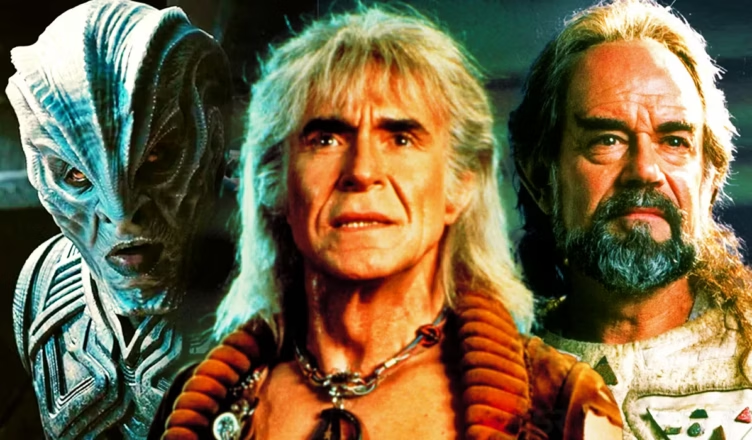
Across 60 years, The Adversaries of Star Trek have done far more than give Starfleet someone to fight. Klingons challenged the possibility of peace. Romulans turned secrecy and suspicion into political weapons. Khan Noonien Singh exposed the danger of superiority without restraint. The Borg threatened individuality itself. The Dominion tested whether Federation principles could survive war, while Q repeatedly forced humanity to confront the limits of its own confidence.
The greatest Star Trek adversaries therefore aren’t simply villains. They are arguments against the future the Federation believes is possible.
Explore The Borg Across Generations
Explore The Federation Across Star Trek
Explore Star Trek 60

When the Enemy Can Become an Ally
The Klingons and Romulans entered Star Trek during an era when the franchise frequently reflected the geopolitical anxieties surrounding its creation. The official history of the Federation’s relationship with the Klingons charts how that relationship shifted across generations, transforming one of Starfleet’s defining enemies into one of its most important allies. Klingons confronted their enemies openly through military strength and competition, while Romulans turned secrecy, intelligence and uncertainty into weapons.
Neither remained frozen in that original role.
By The Next Generation, Worf could serve aboard the Enterprise, transforming a former enemy into one of Starfleet’s own officers. The Undiscovered Country made that evolution the story itself, using the destruction of Praxis and the possibility of peace to expose how difficult it can be for people shaped by conflict to imagine life without an enemy. Peace required more than diplomats signing agreements. Kirk had to confront prejudices forged through decades of hostility and the murder of his son.
The Romulans followed a more complicated path. “Balance of Terror” had already challenged easy assumptions about an enemy by revealing their physical connection to Vulcans, while later stories introduced Romulans willing to question their government, pursue cooperation or recognize common interests with the Federation. Political distrust repeatedly rebuilt the walls between them, but Star Trek resisted the idea that an entire civilization could be reduced to its government.
Together, the Klingons and Romulans establish one of the central ideas running through The Adversaries of Star Trek: an enemy is not necessarily a permanent condition. Governments change, alliances shift and individuals cross boundaries their societies insist should remain fixed. Today’s adversary can eventually become tomorrow’s ally.
When the Conflict Becomes Personal
Not every enemy represents another civilization. Sometimes the threat becomes more powerful precisely because it narrows to one person. Khan Noonien Singh doesn’t want to destroy the Federation in The Wrath of Khan. He wants James T. Kirk. The official Star Trek history of Khan examines how the genetically engineered ruler’s intelligence, strength and ambition ultimately became consumed by vengeance. Years of exile transform that arrogance into obsession until defeating Kirk matters more than Khan’s own survival.
Q makes the conflict personal in an entirely different way. He possesses power Khan could scarcely imagine, yet conquest has never been his real interest. From “Encounter at Farpoint,” Q places humanity itself on trial, disrupts Picard’s certainty, throws the Enterprise into its first confrontation with the Borg and repeatedly challenges the assumption that technological progress necessarily proves moral advancement. Where Khan believes himself superior to humanity, Q demands that humanity demonstrate it has actually become better.
Together, they turn the adversary into a mirror. Kirk and Picard command starships representing an optimistic future, but neither captain is allowed to assume that future has earned its confidence. Khan attacks Kirk through his past, age and mortality, while Q challenges Picard’s faith in humanity’s progress. Their methods couldn’t be more different, but both force Star Trek’s captains to confront uncomfortable truths about themselves and the civilizations they represent. Sometimes the most dangerous adversary isn’t the one threatening the future. It’s the one forcing you to prove you deserve it.

When the Threat Is Losing Yourself
The Borg take that idea somewhere darker because their objective isn’t simply defeating an opponent. It is erasing one.
Assimilation converts biology into technology, memories into Collective knowledge and individuals into drones. Jean-Luc Picard’s transformation into Locutus makes that violation personal, while Seven of Nine later reveals how difficult reclaiming an identity can become after years inside the hive mind.
As explored in The Borg Across Generations, the Collective becomes a dark reflection of the Federation. Both connect radically different species across enormous distances and accumulate knowledge from civilizations throughout the galaxy. The difference is fundamental: the Federation asks different people to build something together without surrendering what makes them distinct, while the Borg eliminate the distinction first.
Picard, Seven, Hugh and other liberated drones ultimately become more important than the cubes attacking Federation space because their survival exposes the flaw inside the Collective’s promise of perfection. The Borg can assimilate memories and technology, but individuality repeatedly reappears. That makes them essential to The Adversaries of Star Trek, challenging one of the franchise’s foundational assumptions: connection should expand identity rather than erase it.
When Winning Can Cost the Federation Itself
The Dominion presents perhaps the most dangerous challenge because defeating it requires the Federation to confront what its principles mean when survival is genuinely uncertain.
The Founders build an empire around order, using genetically engineered servants, political manipulation and overwhelming military power to ensure that the chaos they associate with “solids” can never threaten them again. Their history of persecution gives their fear an understandable origin, but protection has become domination.
Deep Space Nine places the Federation inside a prolonged war against that system, stripping away the relative security surrounding many earlier Star Trek adventures. Casualties accumulate, alliances become necessary and compromise becomes harder to distinguish from surrendering principle. Sisko’s choices increasingly occupy that uncomfortable territory, particularly in “In the Pale Moonlight,” where the question isn’t simply whether bringing the Romulans into the war will save lives. It is what Sisko is willing to permit in order to make that happen.
That makes the Dominion essential to The Adversaries of Star Trek, because defeating it requires the Federation to consider how much of itself it is willing to sacrifice in order to survive. The Founders don’t merely threaten Starfleet militarily. They create circumstances in which the Federation could compromise itself while trying to preserve itself. Victory alone isn’t enough if the Federation can no longer recognize itself afterward.
The Enemy Reveals the Federation
Taken together, The Adversaries of Star Trek form something larger than a rogues’ gallery because each places pressure on a different part of the future the Federation claims to represent. Klingons and Romulans test whether generations shaped by conflict can move beyond inherited distrust, while Khan exposes what happens when extraordinary ability becomes justification for domination. Q approaches the same question from the opposite direction, possessing almost unlimited power while repeatedly challenging humanity to prove that technological advancement has been accompanied by wisdom.
The Borg and Dominion push those ideas beyond individual confrontations. Assimilation threatens the right to remain an individual, transforming the Borg into a dark reflection of a Federation that also connects different civilizations but allows them to retain their identities. The Dominion tests that Federation from another direction, creating circumstances in which survival itself can become an argument for compromise. Sisko’s choices during the Dominion War matter because defeating the Founders isn’t the only measure of victory. The Federation must still recognize itself when the fighting ends.
That is why some of Star Trek’s most meaningful victories don’t involve destroying an enemy. Peace with the Klingons matters because both sides eventually imagine a relationship beyond conflict. Picard’s decision to recognize Hugh as an individual matters because doing so affirms the very principle the Borg deny. Even the uneasy alliances with Romulans demonstrate that political hostility doesn’t eliminate the possibility of common purpose. The adversary creates the pressure, but the response reveals what Starfleet’s principles actually mean.
Why Star Trek Still Needs Its Adversaries
That pressure is essential to Star Trek’s optimism. The franchise has never argued that humanity becomes better because fear, ambition, prejudice, authoritarianism and vengeance simply disappear from the future. Instead, six decades of stories suggest that progress must continually be defended against those impulses, including when they emerge inside the institutions and people who believe they have already moved beyond them.
That is also why the franchise’s adversaries are allowed to evolve. Klingons can move from enemies to allies without erasing the wars that preceded peace. Romulans can remain political rivals while individual Romulans reach across the divide. Former Borg can recover identities the Collective attempted to erase, while the Dominion War can end without requiring the Federation to become another occupying empire. Even Q’s judgment of humanity remains unresolved because humanity itself remains unfinished. The future isn’t a destination where everyone finally learns the correct answers. It is a place where each generation inherits the responsibility to confront the questions again.
Ultimately, The Adversaries of Star Trek matter because they force those questions into the open. Peace means more when former enemies have to build it. Individuality becomes precious when something threatens to erase it. Principles reveal their value when abandoning them would be easier, and progress becomes meaningful only when people recognize that achieving it once doesn’t guarantee it forever. The Klingons, Romulans, Khan, Borg, Dominion and Q may challenge the Federation in radically different ways, but each forces Star Trek to demonstrate why its vision of the future is worth defending.
For 60 years, that tension has kept the franchise’s optimism from becoming complacency. Star Trek doesn’t imagine that humanity eventually reaches a future without conflict. It imagines that humanity can become better at deciding what conflict will turn it into. The future isn’t defined by whether adversaries still exist. It is defined by whether encountering one requires us to become one ourselves.
Continue the Voyage
← Previous: The Borg Across Generations
Explore the Hub: Star Trek 60 | Celebrating 60 Years of the Final Frontier
Upcoming → The Captains of Star Trek
TheFilmGordon’s Star Trek 60 celebration continues with new stories exploring the voyages, captains, crews, starships, worlds, adversaries and ideas that have shaped the Final Frontier.
Discover more from FilmGordon
Subscribe to get the latest posts sent to your email.