by Tim Gordon
The Borg Across Generations: Star Trek’s Most Terrifying Enemy
The Borg Across Generations traces one of Star Trek’s most dramatic evolutions. When the Borg first appeared in The Next Generation, they weren’t interested in territory, revenge or political power. They wanted something far more unsettling: everything that made another civilization distinct.
Technology. Knowledge. Biology. Identity.
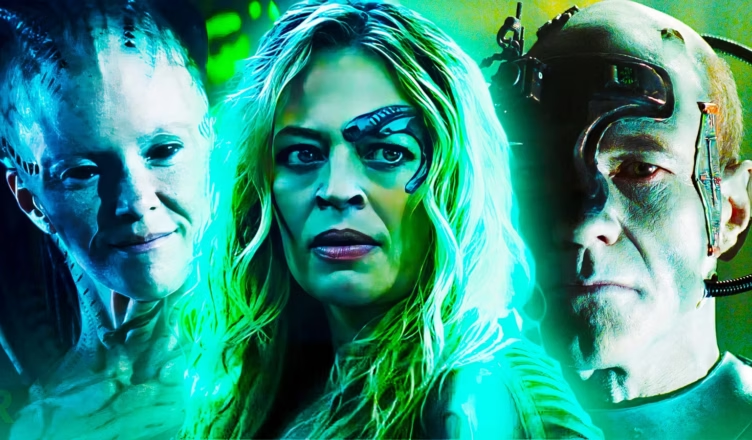
Assimilation turned conquest into erasure, making the Borg unlike nearly every adversary the Federation had encountered. But across The Next Generation, First Contact, Voyager and Picard, the Collective gradually became something more complicated. Through Jean-Luc Picard, Seven of Nine, Kathryn Janeway and the Borg Queen, Star Trek transformed an apparently unstoppable enemy into a decades-long examination of individuality, trauma and whether anyone can truly escape the Collective once it has become part of them.
Explore The Next Generation: The Federation at Its Peak
Explore Voyager: The Federation in Isolation
Explore Picard: The Weight of Legacy
When Resistance Became Futile
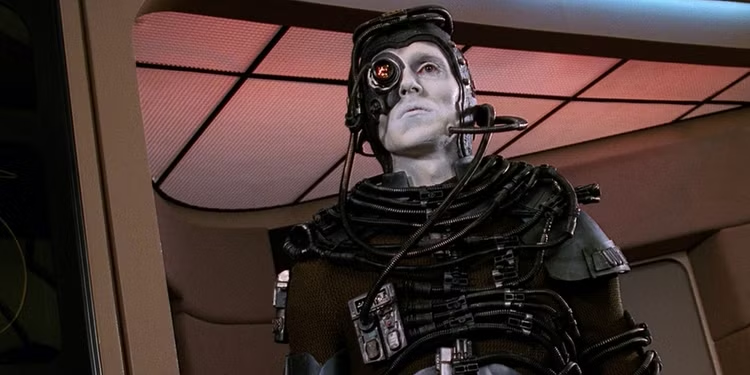
The Borg arrive in “Q Who” without the familiar motivations Star Trek usually gives its antagonists. They don’t hate humanity. They aren’t trying to prove ideological superiority. They barely seem interested in conversation.
They simply assess whether something is useful and take it.
That emotional emptiness makes them frightening. A Klingon can be reasoned with through honor. A Romulan may be motivated by politics, security or ambition. The Borg don’t require any of those things. Their objective is improvement through absorption, reducing entire civilizations to raw material for the Collective.
For the crew of the Enterprise-D, the encounter is also a warning. Q hasn’t merely transported them across space. He has shown Picard that humanity isn’t prepared for everything waiting beyond familiar territory.
The warning becomes prophecy when the Borg eventually come to them.
Locutus Makes the Borg Personal
“The Best of Both Worlds” changes everything because the Borg stop being an abstract threat and take Jean-Luc Picard.
Assimilation is terrifying precisely because Picard survives it. His body becomes Borg machinery, his knowledge becomes Collective intelligence and his identity is buried beneath Locutus. Starfleet is forced to confront its greatest enemy through the face of one of its greatest captains.
Picard is eventually rescued, but rescue doesn’t restore the man who existed before assimilation. “Family” understands that immediately, allowing Picard’s grief and humiliation to surface after the machinery has been removed.
That distinction becomes essential to The Borg Across Generations. The Collective can be escaped physically while remaining psychologically present.
First Contact carries that trauma forward years later. Picard’s confrontation with the Borg isn’t simply another mission because he has already lived inside them. His anger exposes something the calm captain rarely permits himself to acknowledge: part of him is still fighting Locutus.
The Queen Gives the Collective a Face
The Borg eventually become more complicated than the faceless Collective introduced in The Next Generation. The official Star Trek history of the Borg Queen traces her role within the Collective, transforming the Borg from an anonymous technological force into an enemy capable of manipulation, obsession and deeply personal confrontation.
The Queen changes the dramatic language of the Borg. She can tempt Data, torment Picard and later develop a dangerous relationship with Janeway. The Collective now possesses a voice capable of explaining, seducing and threatening.
That evolution also makes The Borg Across Generations increasingly personal. Picard experiences assimilation as violation. Janeway encounters the Collective as an adversary she can confront, negotiate with and sometimes outmaneuver. Seven of Nine forces Star Trek to ask what happens after someone escapes.
The Borg are no longer simply coming for the Federation. They have already changed the people fighting them.
Voyager Enters Borg Space
Voyager changes the scale of the conflict again.
Stranded in the Delta Quadrant, Janeway’s crew doesn’t encounter the Borg as a distant threat approaching Federation territory. They enter the region of space where the Collective is dominant.
That proximity removes some of the Borg’s mystery but expands their civilization. Cubes become part of a much larger infrastructure. Transwarp corridors reveal the enormous reach of the Collective. Unimatrix Zero suggests individuality can survive even within assimilation.
Janeway also approaches the Borg differently from Picard. His relationship with them is inseparable from what they did to him. Janeway has enough distance to treat them strategically, even forming a temporary alliance when Species 8472 threatens both Voyager and the Collective.
The Borg remain terrifying, but they are no longer unknowable.
Then Janeway takes one of them home.

Seven of Nine Survives the Collective
Seven of Nine transforms the Borg story because defeating them is no longer the only question.
The official Star Trek profile of Seven recounts her assimilation as a child, liberation by Voyager and gradual reclamation of an identity beyond the Collective. Annika Hansen was taken before she had the opportunity to become an adult. When Voyager separates her from the Borg, Janeway isn’t restoring a fully formed identity.
Seven has to build one.
That makes her journey fundamentally different from Picard’s. Picard desperately wants to recover the life assimilation interrupted. Seven barely remembers a life before assimilation.
Through Seven, The Borg Across Generations shifts from invasion to identity. She learns friendship, humor, loyalty, grief and eventually love, while remnants of Borg technology remain physically embedded within her.
By the time Seven reappears in Picard, she has spent decades outside the Collective. The Borg remain part of her history without defining the entirety of her future.
That makes Seven one of Star Trek’s clearest rebuttals to the Collective’s most famous declaration.
Resistance wasn’t futile. Seven survived long enough to become herself.
Picard Returns to the Borg
Picard brings the Borg story back to the man whose assimilation made the Collective personal decades earlier.
Jean-Luc has lived a lifetime since Locutus, yet the experience remains woven into his identity. Seven carries the same contradiction. Both escaped the Borg. Neither can pretend assimilation never happened.
Their presence together reframes the Collective through survival rather than conquest. Picard and Seven understand one another in ways few other people can because both know what it means to have their individuality taken from them and then face the difficult task of rebuilding it.
Season 3 makes that connection generational.
The Borg’s final attack doesn’t simply target Picard. It reaches his son Jack and turns Starfleet’s younger officers against the older generation. Assimilation evolves again, exploiting biology and Starfleet’s interconnected technology rather than relying entirely on traditional drones.
The threat that once entered the Federation through Picard now attempts to travel through his bloodline.
What The Borg Across Generations Reveals About Star Trek
That progression is what gives The Borg Across Generations its lasting power.
The Borg begin as the ultimate external threat: a civilization without recognizable individuality moving relentlessly toward the Federation. Then Locutus makes the threat personal. Seven turns assimilation into a question of recovery. Janeway demonstrates that the Collective can be strategically challenged. Picard transforms the conflict into something inherited across generations.
Through all of those changes, the central argument remains remarkably consistent.
The Borg believe perfection requires surrendering individuality.
Star Trek argues the opposite.
Picard’s value comes from remaining Picard after Locutus. Seven’s humanity isn’t determined by removing every trace of Borg technology from her body. Hugh becomes dangerous to the Collective because individuality gives him something assimilation cannot completely erase.
The Borg seek perfection through sameness, while Star Trek’s Federation is built around the possibility that difference can become strength.
Resistance Was Never Just About Survival
That is why the Borg endure beyond their machinery, cubes and chilling declarations.
They attack one of Star Trek’s foundational beliefs: that individual lives matter.
Assimilation offers freedom from loneliness, uncertainty and disagreement. No one inside the Collective has to wonder whether they belong because belonging is compulsory. No one has to struggle with identity because identity has been eliminated.
For Picard and Seven, escaping the Borg means accepting all the complications individuality brings with it. Pain returns. Loneliness returns. Choice returns.
So does possibility.
Across decades of storytelling, the Borg evolve from faceless drones into something more psychologically complex, but the fundamental conflict never changes. The Collective wants every voice to become one voice. Star Trek keeps insisting that civilization becomes richer when those voices remain distinct.
For 60 years, the franchise has imagined humanity encountering civilizations radically different from itself. Few adversaries have challenged its philosophy as directly as the Borg.
They promised perfection.
Picard chose himself.
Seven built herself.
And generation after generation kept resisting.
The Borg Across Generations ultimately reveals why resistance was never futile. Resistance is what allows the individual to survive.
Continue the Voyage
← Previous: Dax Across the Centuries
Explore the Hub: Star Trek 60 | Celebrating 60 Years of the Final Frontier
Upcoming → The Klingons: From Enemy to Ally
TheFilmGordon’s Star Trek 60 celebration continues throughout September with new stories exploring the voyages, captains, crews, starships, worlds, adversaries and ideas that have shaped the Final Frontier.
Discover more from FilmGordon
Subscribe to get the latest posts sent to your email.