by Tim Gordon
Star Trek: Voyager took the Federation farther from home than any Star Trek series before it, stranding Captain Kathryn Janeway and her crew 70,000 light-years from Earth and asking a deceptively simple question: What do Federation principles mean when the Federation isn’t there to enforce them?
For seven seasons, the USS Voyager carried more than a crew through the Delta Quadrant.
It carried an idea of home.
Voyager Took Starfleet Beyond the Federation
When Voyager premiered in 1995, Star Trek had already begun dismantling the comfortable assumptions of The Next Generation.
Deep Space Nine placed the Federation on a contested frontier.
Star Trek: Voyager went further.
It removed the Federation almost completely.
While searching for a missing Maquis ship in the Badlands, Voyager is pulled across the galaxy by the powerful entity known as the Caretaker. Janeway ultimately destroys the technology that might have returned her crew home rather than allow it to fall into the hands of the Kazon.
The decision leaves Voyager approximately 70,000 light-years from Earth.
There would be no nearby starbases. No routine resupply. No reinforcements. No Starfleet Command waiting on the other side of a subspace channel.
That made Voyager more than another exploration vessel.
It became a small, moving piece of the Federation.
The official Star Trek: Voyager series archive chronicles the seven-season journey that carried Janeway and her crew across the Delta Quadrant in search of a way home.
Janeway Had to Carry the Federation With Her
Kathryn Janeway faced a command problem unlike Kirk, Picard or Sisko.
Her mission wasn’t simply exploration.
It was survival without surrendering the principles that defined Starfleet.
Janeway could have treated Federation law and the Prime Directive as luxuries belonging to another part of the galaxy. Instead, she repeatedly insisted that distance from home didn’t release her crew from responsibility.
She could be compassionate and curious, but also stubborn, severe and willing to make decisions that divided the people around her.
Nobody was watching.
That was precisely why the principles mattered.
But Janeway also had to build a crew from people who hadn’t necessarily chosen to serve together. The Starfleet officers merged with the Maquis they had been pursuing. Chakotay became Janeway’s first officer, while B’Elanna Torres, a Starfleet dropout and Maquis fighter, became chief engineer.
Former adversaries now shared one destination.
Home.
Over time, Voyager became more than transportation. Tom Paris and B’Elanna built a family. Harry Kim grew far beyond the young officer who had expected his first assignment to be an adventure. The Emergency Medical Hologram became the Doctor, developing friendships, ambitions and an identity that forced the crew to reconsider what constituted a person.
Isolation turned a collection of officers, rebels, outsiders and artificial life into a community.
Seven of Nine Made the Journey About Identity
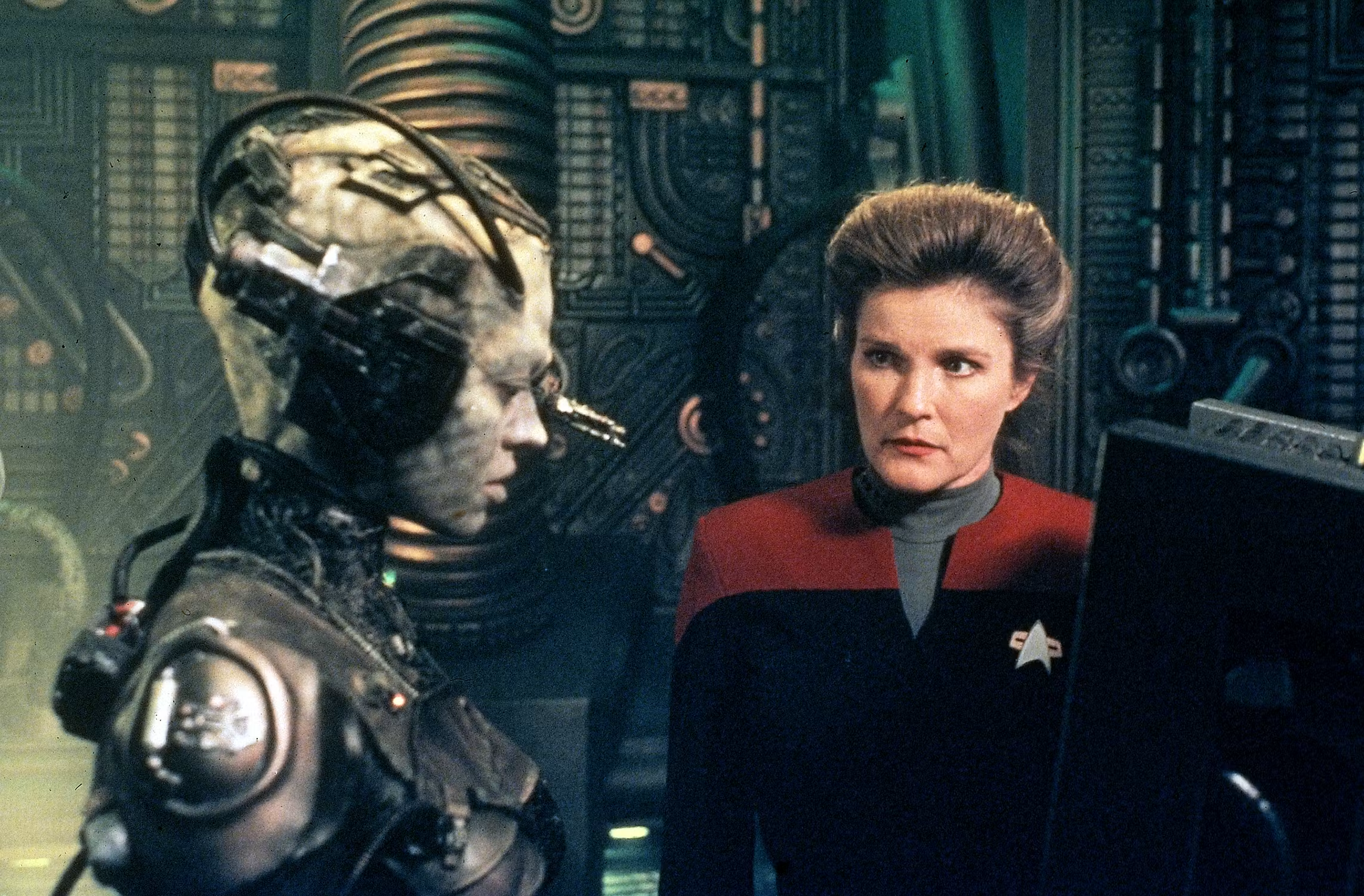
No character embodied Voyager’s questions about belonging more powerfully than Seven of Nine.
She had been assimilated by the Borg as a child and spent most of her life inside the Collective. When Voyager separated her from it, Seven didn’t consider herself rescued.
Individuality frightened her.
Janeway became central to Seven’s reconstruction of the person she had once been. Their relationship could be maternal, adversarial and philosophical, with Janeway insisting that Seven possessed an individuality worth recovering while Seven challenged many of Janeway’s assumptions about humanity.
Through Seven, Star Trek: Voyager turned the journey home inward.
What does home mean when you barely remember it?
What does humanity mean when most of your life has been spent without individuality?
Can someone reclaim an identity after another culture has almost completely erased it?
Seven also changed the Borg. The almost unknowable enemy introduced in The Next Generation could now be examined from within. Behind every drone was potentially someone whose individuality had been taken away.
For Seven, reaching Earth wouldn’t simply complete Voyager’s journey.
She had to discover who would arrive there.
The Delta Quadrant Made Exploration Cost Something
The Delta Quadrant gave Voyager an enormous canvas.
The Kazon, Vidiians, Hirogen, Species 8472, the Borg and countless unfamiliar civilizations encountered a Federation vessel whose reputation often hadn’t preceded it.
Every first contact was an opportunity to demonstrate what Starfleet represented.
But exploration now carried a price.
Every detour potentially delayed the journey home. Every damaged system consumed resources that might be difficult to replace. Every lost crew member was someone Starfleet couldn’t simply replace.
Even the Intrepid-class USS Voyager, with its bio-neural circuitry, variable-geometry warp nacelles and planetary landing capability, remained a finite collection of resources traveling through unfamiliar territory.
That created the central tension of the voyage.
The crew wanted to explore.
They also wanted to get home.
Sometimes those goals collided.
And every time they did, Voyager returned to the question beneath the entire series:
Are Federation principles still principles when following them makes survival harder?
Voyager Made Home a Choice
Eventually, the isolation began to break.
The crew established communication with the Alpha Quadrant. Starfleet learned they were alive. Families who had mourned them discovered they were still coming home.
Earth stopped being merely a memory.
It became a destination again.
But by “Endgame,” the people returning weren’t the same people who had disappeared seven years earlier.
Some hadn’t begun the journey as Starfleet officers.
Some weren’t human.
Some hadn’t been born when it started.
And Seven had spent most of her life believing the Federation meant nothing to her.
That may be Voyager’s most important contribution to Star Trek.
The Federation wasn’t simply territory.
It wasn’t Starfleet Headquarters.
It wasn’t Earth.
For seven years, the Federation existed wherever Voyager’s crew chose to practice its ideals.
They sometimes upheld those principles. Sometimes they argued over them. Sometimes they failed to meet them.
But they kept trying.
Deep Space Nine asked whether Federation ideals could survive war.
Star Trek: Voyager asked whether they could survive isolation.
The answer traveled 70,000 light-years.
The crew didn’t spend seven years simply trying to reach the Federation.
They spent seven years carrying it home.
Continue the Voyage
← Previous: Benjamin Sisko: Captain, Emissary, Legend
Explore the Hub: Star Trek 60 | Celebrating 60 Years of the Final Frontier
Upcoming → Enterprise: Before the Federation | September 15
TheFilmGordon’s Star Trek 60 celebration continues throughout September with new stories exploring the voyages, captains, crews, starships, worlds, adversaries and ideas that have shaped the Final Frontier.
Discover more from FilmGordon
Subscribe to get the latest posts sent to your email.