by Tim Gordon
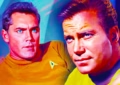
The Star Trek First Officers Who Stood Beside the Captain
Star Trek First Officers occupy one of the most fascinating positions in the franchise. They stand beside the captain, but their responsibility is not simply to follow. Across sixty years of Star Trek, the first officer has served as confidant, challenger, protector, strategist, successor and, sometimes, the conscience of command.
Spock brought logic to Kirk’s instinct.
William Riker gave Picard a commander willing to challenge him.
Kira Nerys stood beside Benjamin Sisko while representing a people and a faith Starfleet could never completely understand.
Chakotay helped Kathryn Janeway transform two opposing crews into one.
Saru became Michael Burnham’s colleague, rival, captain, friend and one of the people who understood her most deeply.
Una Chin-Riley helped define the position before many of them.
And Raffi Musiker now occupies the chair beside Seven of Nine aboard the Enterprise-G.
The captain makes the final decision.
But Star Trek has spent six decades reminding us that great captains rarely reach those decisions alone.
Sometimes the most important person on the bridge is the one sitting immediately beside them.

Una Chin-Riley | Number One
Before audiences knew William Riker, Chakotay or Kira Nerys, there was simply Number One.
Una Chin-Riley served as Christopher Pike’s first officer aboard the Enterprise, originating in Star Trek’s first pilot, “The Cage.” The character was unusual from the beginning. A woman occupying the second-highest position aboard a starship in a 1960s television pilot represented a future television itself was not yet prepared to embrace.
The original pilot wasn’t picked up in its initial form, and Number One disappeared from the bridge when Star Trek was reconfigured around Kirk.
Decades later, Strange New Worlds restored her.
And it gave her a name, history and identity beyond the title.
Una is disciplined, formidable and deeply trusted by Pike. But her story also exposes a contradiction within the Federation she serves. As an Illyrian whose genetic modifications violate Federation law, she belongs to an institution whose ideals of inclusion do not always match its policies.
That makes Una particularly important among the Star Trek First Officers.
She doesn’t simply help Pike command.
Her existence forces Starfleet to examine whether the future it celebrates is actually as enlightened as it believes.
The first Number One became something more than a historical curiosity.
She became a test of Starfleet’s principles.
Spock | Logic Beside Instinct
Spock’s relationship with James T. Kirk established one of Star Trek’s foundational command dynamics.
Kirk sits in the center chair.
Spock stands nearby.
Leonard McCoy frequently completes the triangle.
Logic.
Emotion.
Decision.
That balance established an early template for the Star Trek First Officers who would follow.
Spock’s role is especially interesting because agreement is not the measure of his loyalty.
He challenges Kirk.
He identifies flaws in assumptions.
He offers alternatives.
And when the captain ultimately chooses another course, Spock understands the distinction between advising command and possessing it.
That is one of the essential responsibilities of the first officer.
A captain surrounded exclusively by people who agree with them is not well served.
Spock’s value comes partly from his willingness to see the problem differently.
Yet the relationship gradually becomes much deeper than professional obligation.
Kirk trusts Spock with his life.
Spock sacrifices himself to save the Enterprise in The Wrath of Khan.
Their friendship ultimately becomes one of the emotional foundations of the franchise.
Spock demonstrates that the best Star Trek First Officers don’t merely support the captain’s authority.
They make the captain better.
William Riker | The Executive Officer
William T. Riker may represent the franchise’s clearest expression of the traditional first officer.
Picard commands the Enterprise-D.
Riker runs it.
Among the Star Trek First Officers, Riker perhaps most clearly demonstrates the difference between commanding a starship and managing one.
That distinction is important.
Picard carries responsibility for the mission and the larger philosophical questions surrounding it. Riker oversees much of the daily operation of the ship, manages personnel and frequently leads away missions that Picard cannot.
He also acts as a protective barrier around the captain.
Where Kirk frequently placed himself directly in danger, The Next Generation established a command structure that recognized the captain’s survival as essential to the ship.
Riker could go where Picard shouldn’t.
But Riker was never merely Picard’s substitute.
He had ambitions of his own.
Starfleet repeatedly offered him commands, and his decisions to remain aboard the Enterprise became an important part of his character. The chair beside Picard wasn’t simply somewhere Riker waited until a better job appeared.
It became where he believed he belonged.
Their relationship matured from captain and subordinate into one built upon extraordinary mutual trust.
When Riker eventually accepted his own command, he carried years of lessons from Picard with him.
The first officer had become the captain.
Exactly as the position is designed to make possible.
Kira Nerys | The Outsider Beside Sisko
Kira Nerys immediately complicates any simple definition of a Starfleet first officer.
For most of Deep Space Nine, she isn’t a Starfleet officer at all.
She is a major in the Bajoran Militia, serving as Benjamin Sisko’s second-in-command aboard a station belonging to Bajor but administered jointly with the Federation.
That distinction gives Kira enormous dramatic importance.
She isn’t there to reinforce Sisko’s worldview.
She represents another one.
Kira survived the Cardassian occupation as a resistance fighter. Her understanding of terrorism, liberation, faith, colonialism and political compromise comes from lived experience rather than Starfleet Academy.
When Sisko views a situation through Federation principles, Kira can see what those principles look like from outside the Federation.
When Sisko becomes the Emissary of the Prophets, their relationship becomes even more complicated.
He is her commanding officer.
He is also a religious figure central to her faith.
Kira must navigate both realities without surrendering her judgment.
That makes her one of the most distinctive Star Trek First Officers.
She isn’t Sisko’s echo.
She is his counterweight.
And Deep Space Nine becomes richer because the person standing beside its commander isn’t always looking at the universe from the same side of the window.
Chakotay | Building One Crew From Two
Kathryn Janeway didn’t choose Chakotay through normal Starfleet procedure.
Circumstance chose him.
When Voyager was stranded in the Delta Quadrant, Janeway’s Starfleet crew and Chakotay’s Maquis crew suddenly faced the same impossible journey home.
They could remain two competing factions trapped aboard one ship.
Or they could become a crew.
Making Chakotay first officer was therefore more than a personnel decision.
It was political architecture.
His presence in the command structure told the former Maquis that they had a voice aboard Voyager while simultaneously requiring Chakotay to help integrate them into Starfleet operations.
That balancing act defined much of his early role.
Janeway and Chakotay didn’t always agree.
They sometimes approached Federation rules differently.
But their relationship became essential to Voyager’s stability.
Chakotay could speak to Janeway differently than most of the crew because his loyalty wasn’t built on unquestioning obedience.
It was built over time.
In a series fundamentally concerned with whether Federation ideals can survive isolation, Chakotay becomes part of the answer.
Voyager didn’t make it home because Janeway commanded alone.
It made it home because two crews eventually learned to become one.

Saru | Rival, Captain, Friend
Few command relationships in Star Trek evolve as dramatically as the relationship between Michael Burnham and Saru.
They begin aboard the Shenzhou under Captain Philippa Georgiou.
Burnham’s mutiny shatters that world.
What follows is not a simple path toward friendship.
Saru distrusts her.
Burnham carries guilt.
Both grow.
Both command.
Both change.
Saru’s personal evolution is remarkable on its own. He begins as a Kelpien shaped by a lifetime of fear, believing his species evolved as prey. His eventual discovery of the truth about Kelpiens transforms his understanding of himself.
That transformation parallels his development as an officer.
Saru becomes captain of Discovery before Burnham eventually takes the chair herself.
This creates something unusual within the Star Trek First Officers tradition. Their relationship cannot be neatly reduced to captain and Number One because those roles shift between them.
At different points, Saru is Burnham’s superior, colleague, challenger and counselor.
What remains is trust.
By Discovery’s later years, their bond represents something the franchise has always understood about command.
Rank establishes authority.
Experience creates respect.
But relationships create crews.
T’Pol | The Vulcan Who Helped Humanity Reach the Stars
T’Pol begins her journey aboard Enterprise as a Vulcan observer assigned to a human crew she does not entirely trust.
That alone makes her an unusual second-in-command.
Archer wants humanity to escape what he considers Vulcan interference.
T’Pol believes humanity is rushing into a galaxy it isn’t prepared to understand.
Both are right often enough to irritate the other.
Their early conflict becomes one of Enterprise’s most important relationships because it mirrors the larger tension between Earth and Vulcan.
Archer represents humanity’s impatience to explore.
T’Pol represents the experience humanity doesn’t yet possess.
Gradually, skepticism becomes loyalty.
T’Pol chooses the Enterprise.
And in doing so, she becomes another example of why the Star Trek First Officers matter.
The person beside the captain doesn’t have to share the captain’s assumptions.
Sometimes their greatest contribution is exposing those assumptions.
Jack Ransom | The Other Side of Number One
Commander Jack Ransom offers Lower Decks an opportunity to poke at nearly every heroic convention associated with the first officer.
He looks the part.
He certainly believes he looks the part.
But beneath the exaggerated confidence and comedic swagger is a capable Starfleet officer.
Ransom’s relationship with Captain Carol Freeman also reveals something important about the Cerritos.
This isn’t the Enterprise.
The ship’s mission frequently involves second contact, infrastructure and diplomatic follow-through. Its command team therefore operates in the less glamorous machinery of Federation expansion.
Ransom demonstrates that the first officer’s job remains necessary even when history isn’t watching.
Someone still has to manage the crew.
Someone still has to lead away missions.
Someone still has to be ready if the captain can’t command.
Even Lower Decks, while affectionately dismantling Starfleet mythology for comedy, ultimately reinforces the institution underneath it.
Raffi Musiker | Beside Seven of Nine
The Enterprise-G gives the first officer tradition another fascinating evolution.
Captain Seven of Nine sits in the center chair.
Commander Raffi Musiker sits beside her.
Their history is anything but conventional.
They have been allies, partners, lovers, estranged companions and Starfleet officers navigating extraordinarily complicated personal terrain.
Now they have to command together.
That makes their relationship potentially unlike any captain-first officer partnership that preceded it.
Seven herself understands the importance of someone challenging authority. Her years aboard Voyager were shaped by frequent disagreements with Janeway, whose mentorship helped Seven rediscover individuality without demanding unquestioning conformity.
Now Seven occupies Janeway’s side of the equation.
Raffi occupies the other chair.
The lineage continues, but the people inside it have changed.
That is exactly what Star Trek does best.
The First Officer Must Be Able to Say No
The first officer’s role has always required more than simply carrying out the captain’s orders. The first officer’s most important word may not be “yes.”
It may be no.
No, Captain, we haven’t considered every possibility.
No, Captain, you shouldn’t lead this away mission.
No, Captain, your judgment may be compromised.
No, Captain, there is another way.
The Star Trek First Officers repeatedly demonstrate that loyalty and obedience are not synonymous.
Spock challenges Kirk.
Riker challenges Picard.
Kira challenges Sisko.
Chakotay challenges Janeway.
Saru challenges Burnham.
Una challenges Pike.
The captain may possess final authority, but Starfleet’s command structure recognizes something profoundly human:
Power benefits from proximity to dissent.
The first officer is close enough to command to understand its burden and far enough from it to recognize when the captain may be wrong.
That isn’t insubordination.
It is part of the job.
The Captain’s Greatest Responsibility Is Creating a Successor
There is another purpose hidden inside the first officer’s chair.
Succession.
A starship cannot depend entirely on one person.
If the captain is injured, captured, compromised or killed, someone must be capable of assuming command immediately.
But succession extends beyond emergencies.
Riker eventually becomes captain.
Saru becomes captain.
Seven of Nine, once Janeway’s unconventional protégé rather than her first officer, eventually reaches the Enterprise.
Starfleet survives because knowledge moves forward.
Captains teach officers who eventually become captains themselves.
Command therefore isn’t simply about making decisions today.
It is about preparing someone else to make them tomorrow.
The chair beside the captain is where that future often begins.
Number One
The phrase sounds almost casual now.
Number One.
But within Star Trek, it carries sixty years of meaning.
It means the captain trusts you.
It means the crew looks to you.
It means you must understand the mission without becoming imprisoned by the captain’s interpretation of it.
It means sometimes standing beside your commander.
Sometimes standing in for them.
And occasionally standing against them.
The Star Trek First Officers reveal something essential about the franchise’s conception of leadership.
Great leaders don’t surround themselves with followers.
They surround themselves with people capable of telling them the truth.
Pike has Una.
Kirk has Spock.
Picard has Riker.
Sisko has Kira.
Janeway has Chakotay.
Burnham has Saru.
Seven has Raffi.
Different generations.
Different relationships.
The same responsibility.
The captain sits in the center chair.
But the future has never been theirs to carry alone.
Continue the Voyage
← Previous: The Captains of Star Trek
Explore the Hub: Star Trek 60 | Celebrating 60 Years of the Final Frontier
Upcoming → The Crews That Made Star Trek | September 5
TheFilmGordon’s Star Trek 60 celebration continues throughout September with new stories exploring the voyages, captains, crews, starships, worlds, adversaries and ideas that have shaped the Final Frontier.
Discover more from FilmGordon
Subscribe to get the latest posts sent to your email.