by Tim Gordon
The Star Trek Captains Who Carried the Mission Across Generations
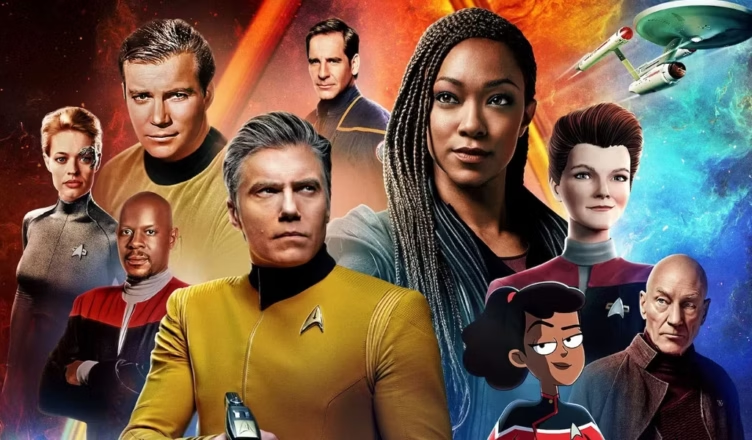
Star Trek Captains have always been more than commanders of starships and space stations. Across sixty years, they have become the people entrusted with translating the Federation’s highest ideals into decisions made thousands of light-years from home, often when there is no perfect answer waiting in the rulebook.
Jonathan Archer had almost no rulebook at all.
Christopher Pike commands with empathy while carrying knowledge of a future he cannot escape.
James T. Kirk turned instinct into an instrument of command.
Jean-Luc Picard made diplomacy feel every bit as formidable as a phaser bank.
Benjamin Sisko discovered that preserving paradise sometimes means confronting what paradise asks others to sacrifice.
Kathryn Janeway carried Federation principles into a quadrant where the Federation could neither protect nor judge her.
Michael Burnham helped rebuild the institution itself after history nearly erased it.
Carol Freeman showed that maintaining the Federation can matter as much as discovering it.
Dal R’El had to learn what command actually meant.
And Seven of Nine traveled perhaps the most improbable road of them all, from Borg drone to captain of the Enterprise.
Different centuries. Different ships. Different philosophies.
The same chair.
For sixty years, Star Trek has repeatedly returned to one fundamental question:
Who should we trust with the future?

Archer, Pike and Kirk Built the Meaning of Command
Before Starfleet captains could quote regulations, someone had to discover why those regulations were necessary.
Jonathan Archer commanded the Enterprise NX-01 before the United Federation of Planets and before the Prime Directive established boundaries generations of captains would inherit. He couldn’t simply ask what Starfleet would do because Starfleet, as later generations understood it, didn’t exist yet.
Archer was learning how humanity should behave among the stars while already traveling through them. His encounters with Vulcans, Andorians, Tellarites and other civilizations helped establish relationships that would eventually contribute to the Federation itself.
Archer didn’t inherit the Federation. He helped humanity become ready for one.
Christopher Pike inherited a more recognizable Starfleet, but brought something different to its center chair.
His defining quality is empathy. He listens. He cooks for his crew. He understands that authority doesn’t require emotional distance. Yet Pike carries an extraordinary burden: knowledge that a catastrophic accident awaits him and that saving others will cost him the future he wants for himself.
His courage isn’t based on believing he will survive.
It comes from knowing what will happen and choosing to live meaningfully anyway.
Then came James T. Kirk, the captain who established for millions of viewers what command looked like.
The caricature sometimes overwhelms the character. Kirk isn’t simply reckless. His great talent is judgment.
He listens to Spock’s logic. He listens to McCoy’s humanity. Then he makes the decision neither man can make for him.
That triangle became one of Star Trek’s foundational dynamics. Kirk’s command wasn’t solitary genius. It was the ability to absorb radically different perspectives and still accept responsibility for the final choice.
Archer learned the rules.
Pike humanized them.
Kirk discovered when the unknown demanded something the rules couldn’t anticipate.
Together, they established the central tension that would define generations of Star Trek Captains: principles matter, but someone still has to decide how to apply them.
Across generations, Starfleet’s captains have reached the center chair through different paths, reflecting how Star Trek continually reimagines the responsibilities of command.
Picard and Sisko Put the Federation to the Test
Jean-Luc Picard didn’t need to become another Kirk because The Next Generation understood that another century should produce another kind of leader.
Picard believed institutions mattered. Law mattered. History mattered. Diplomacy mattered.
His greatest weapon was frequently conversation.
That didn’t make Picard passive. It made restraint active.
He could confront Q, the Borg, Romulans and hostile civilizations without allowing their behavior to determine his own. Picard represented the Federation at perhaps its most confident, a civilization convinced that reason could solve problems violence could not.
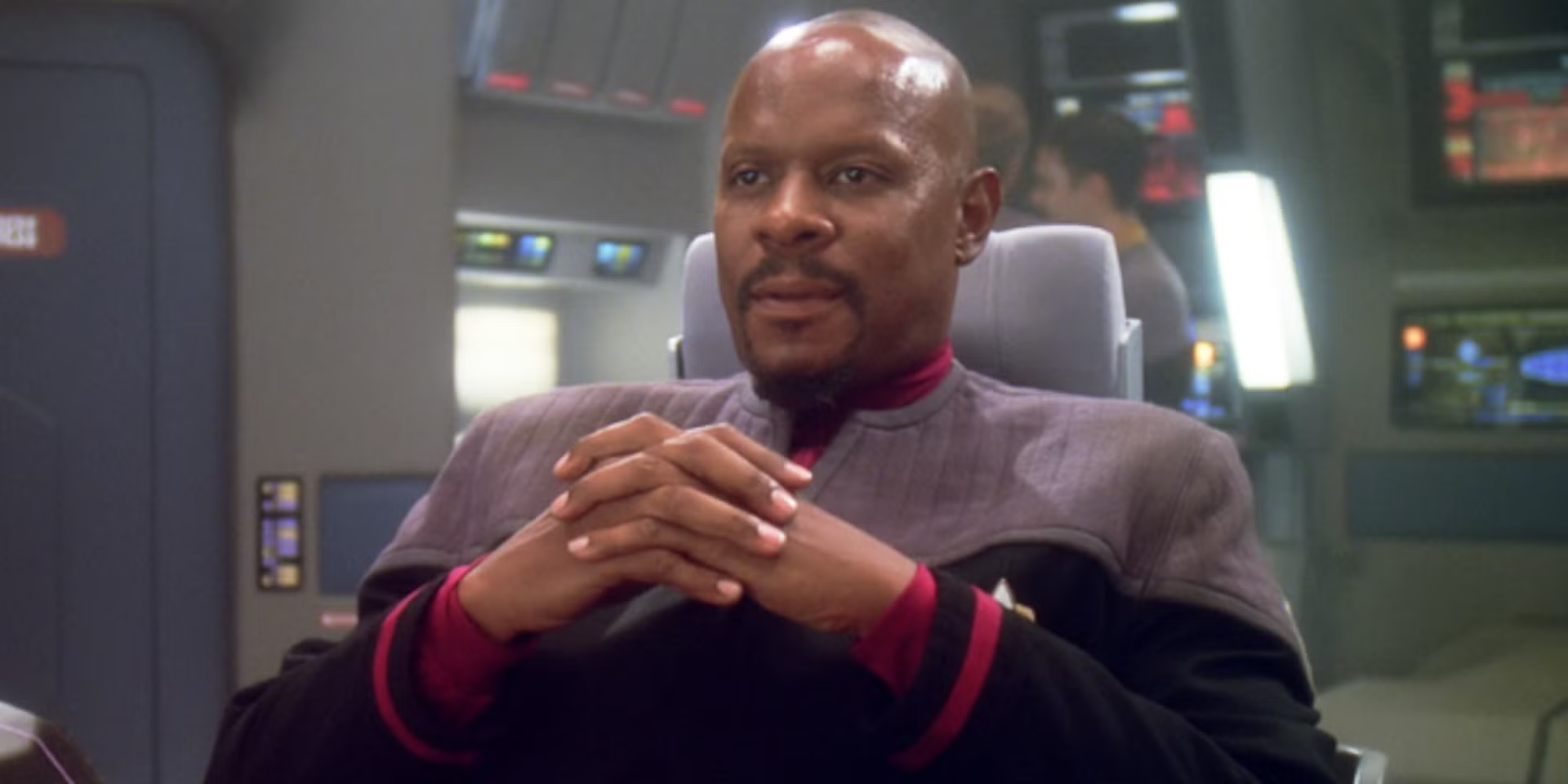
Then Deep Space Nine asked what happened when that confidence encountered war.
Benjamin Sisko had to be different because his circumstances were different.
Deep Space 9 couldn’t simply warp away from its problems. Sisko arrived as a commander grieving his wife and questioning his future in Starfleet. Then the discovery of the Bajoran wormhole transformed the station into one of the most strategically important locations in the quadrant, while the Bajorans identified Sisko as the Emissary of the Prophets.
Command, politics, religion, fatherhood and destiny suddenly occupied the same office.
Then came the Dominion War.
Picard frequently represents the Federation as it wishes to see itself.
Sisko confronts what happens when that Federation believes its survival is at stake.
He compromises. He carries consequences. And Deep Space Nine refuses to pretend those compromises disappear simply because the mission succeeds.
Sisko doesn’t invalidate Star Trek’s optimistic future.
He asks what preserving that future might cost.
Together, Picard and Sisko reveal something essential about the Star Trek Captains. Leadership isn’t merely about believing in principles when civilization is secure.
The debate over what makes a great captain has followed Star Trek for decades, with Jean-Luc Picard once emerging as the favorite in an official StarTrek.com captain poll measuring qualities including courage, intelligence, decisiveness and inspiration.
It is about deciding what those principles mean when civilization isn’t.
Janeway and Burnham Carried the Federation Beyond Its Borders
Kathryn Janeway faced a command problem no previous Star Trek captain had encountered on quite the same scale.
The Federation disappeared behind her.
When Voyager became stranded roughly 70,000 light-years from home, Janeway couldn’t call Starfleet Command. There were no reinforcements, nearby starbases or admirals waiting to review her decisions.
She also had to transform Starfleet officers and Maquis rebels into a functioning crew while maintaining the values of an institution most of them might not see again for decades.
That made Janeway both captain and Federation.
Every compromise had to answer the same underlying question:
Do Federation principles still matter when nobody is watching?
Janeway’s answer was usually yes, although rarely without complications.
Seven years later, she brought her crew home.
Michael Burnham traveled even farther from the Federation audiences knew.
Her journey began not with command, but with failure. Burnham’s mutiny during the Battle of the Binary Stars destroyed her career and left her carrying enormous guilt. Her path toward the center chair became a story about learning what leadership required rather than merely regaining rank.
Then Discovery entered the 32nd century.
The Federation Burnham encountered had been devastated by the Burn. Worlds had withdrawn from one another and the institution itself had become a diminished version of what it once was.
Kirk explored the Federation’s frontier.
Picard represented its confidence.
Sisko defended it.
Janeway carried its values in isolation.
Burnham helped rebuild it.
That makes Janeway and Burnham fascinating counterparts among the Star Trek Captains.
One discovered whether Federation ideals could survive without the institution.
The other discovered whether the institution could survive because people still believed in its ideals.
Freeman, Dal and Seven Expanded Who Could Sit in the Chair
Not every captain gets the Enterprise.
Captain Carol Freeman’s Cerritos specializes in second contact and support missions, the work that happens after more glamorous vessels make their historic discoveries.
Someone has to establish relationships. Implement agreements. Keep the machinery of the Federation operating.
Lower Decks turns that reality into comedy, but Freeman’s role makes a serious point underneath it.
Civilizations aren’t maintained exclusively by legendary people performing legendary acts.
They survive because professionals do the work.
Prodigy approaches command from another direction.
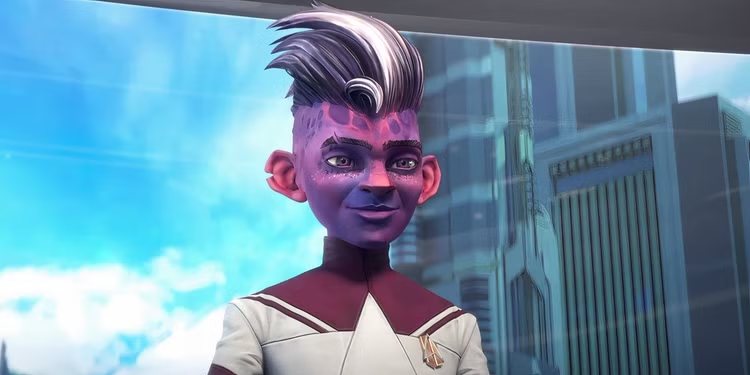
Dal R’El doesn’t begin as a Starfleet officer. He simply wants the chair.
His journey aboard the Protostar teaches him that being captain isn’t about possessing authority. It’s about becoming responsible for other people.
Duty. Sacrifice. Trust. Teamwork.
Dal has to learn all of them, demonstrating that the Federation’s future depends not merely on preserving its institutions but inspiring new people to believe they are worth joining.
And then there is Seven of Nine.
A child assimilated by the Borg.
A drone stripped of individuality.
Liberated aboard Voyager.
Mentored by Kathryn Janeway.
A woman who spent years trying to understand humanity while humanity frequently struggled to accept her.
By the conclusion of Picard, Seven takes command of the ship that becomes the Enterprise-G.
The symbolism is extraordinary.
The Borg once represented one of Starfleet’s greatest existential threats. Picard was assimilated by them. Janeway fought them. Seven survived them.
Now she commands the Enterprise.
Seven’s remarkable journey from Borg drone to Starfleet captain is chronicled in the official history of Seven of Nine, tracing a character whose struggle for individuality ultimately carried her toward Starfleet.
The woman who once belonged to a Collective has been entrusted with a ship whose name represents generations of individuals choosing to work together.
That isn’t simply promotion.
It is Star Trek distilled into one captain’s chair.
There Is No Single Way to Command
The enduring fascination with the Star Trek Captains comes partly from the fact that the franchise has never settled on one definition of ideal leadership.
Archer couldn’t command like Picard because Picard’s Federation didn’t exist yet.
Sisko couldn’t command like Kirk because Deep Space 9 couldn’t leave its problems behind.
Janeway couldn’t command like Picard because there was no Federation surrounding her.
Burnham couldn’t preserve an institution that first needed rebuilding.
Freeman reminds us that leadership also happens outside history’s spotlight.
Dal shows us that command must be learned.
Seven proves that the people entrusted with an institution’s future don’t have to resemble the people who built its past.
And Pike reminds us that knowing the cost doesn’t absolve a leader from paying it.
Different captains answer the same question differently:
What does this moment require of me?
That may be the true responsibility of the center chair.
The Chair Is Never Really Empty
Starships change.
Uniforms change.
Starfleet changes.
Even the Federation changes.
But eventually someone sits in the center chair.
Around them are people with greater expertise in science, engineering, medicine, navigation, communications and security.
The captain cannot know everything.
That was never the job.
The job is to listen. To decide. To accept responsibility. To know when regulations protect the mission and when circumstances demand that they be questioned. To recognize when strength requires firing phasers and when it requires refusing to.
For sixty years, the Star Trek Captains have given audiences radically different models of leadership.
Instinct.
Intellect.
Empathy.
Discipline.
Conviction.
Persistence.
Hope.
None is perfect.
That may be why they endure.
Because Star Trek has never really argued that the future will be created by perfect people.
It argues that the future will depend upon people willing to accept responsibility for what happens next.
The chair waits.
Someone sits down.
The viewscreen fills with stars.
And another voyage begins.
Continue the Voyage
← Previous: The Enterprise Legacy
Explore the Hub: Star Trek 60 | Celebrating 60 Years of the Final Frontier
Upcoming → The First Officers of Starfleet | September 4
TheFilmGordon’s Star Trek 60 celebration continues throughout September with new stories exploring the voyages, captains, crews, starships, worlds, adversaries and ideas that have shaped the Final Frontier.
Discover more from FilmGordon
Subscribe to get the latest posts sent to your email.