by Tim Gordon
The Star Trek Enterprise Legacy Spans Generations
Star Trek Enterprise Legacy is the story of a name that has traveled across centuries, connecting Jonathan Archer, Christopher Pike, James T. Kirk, Jean-Luc Picard and generations of Starfleet officers. Ships have changed. Captains have changed. Even the Federation itself has changed. But the name remains: Enterprise.
But the name remains.
Enterprise.
Before there was a Federation, there was an Enterprise.
Before James T. Kirk sat in the center chair, Jonathan Archer carried the name into deep space.
Long after Kirk’s legendary five-year mission ended, new starships would inherit the designation NCC-1701 and add another letter to a lineage that became inseparable from Starfleet itself.
NX-01.
NCC-1701.
1701-A.
B.
C.
D.
E.
F.
G.
Different ships. Different crews. Different centuries.
One continuing mission.
In a universe filled with legendary vessels, from Voyager and Defiant to Discovery, Cerritos and Protostar, no name carries quite the same weight.
The Enterprise isn’t simply another starship.
It is Star Trek remembering who it wants to be.

Before the Federation, There Was Enterprise
The lineage begins before the institution that would eventually make the name legendary. Captain Jonathan Archer’s Enterprise NX-01 represented something humanity had never possessed before: a starship capable of carrying people far enough into the galaxy to discover how little they understood about it.
The NX-01 therefore occupies a unique position within the Star Trek Enterprise Legacy, beginning a lineage before the Federation itself existed.
Captain Jonathan Archer’s Enterprise NX-01 represented something humanity had never possessed before: a starship capable of carrying people far enough into the galaxy to discover how little they understood about it.
Archer wasn’t commanding the flagship of an established interstellar superpower.
He was helping create one.
The NX-01 launched during an era when humanity’s relationships with Vulcans, Andorians, Klingons and countless other civilizations were uncertain, frequently hostile and sometimes dangerous. Earth’s explorers possessed enthusiasm in greater quantities than experience.
There was no Federation to protect them.
There was barely a rulebook.
That makes Archer’s Enterprise fundamentally different from nearly every vessel that inherited its name.
It wasn’t representing the Federation.
It was helping make the Federation possible.
By the end of Archer’s journey, relationships among Humans, Vulcans, Andorians and Tellarites had begun forming the political foundation that would eventually become the United Federation of Planets. The NX-01 therefore occupies a unique position within The Enterprise Legacy.
Every Enterprise that followed would carry Federation ideals into the galaxy.
Archer’s helped create the conditions under which those ideals could exist.
The Enterprise That Defined Star Trek
Then came U.S.S. Enterprise NCC-1701
Few silhouettes in popular culture are more immediately recognizable.
The saucer.
The engineering hull.
Two warp nacelles suspended above and behind it.
Matt Jefferies’ design didn’t resemble the rockets audiences associated with space travel in the 1960s. The ship looked as though it belonged to a civilization that had already mastered the stars.
And aboard it, the Star Trek Enterprise Legacy discovered the identity that would carry the franchise across generations.
Robert April commanded the Enterprise before Christopher Pike. Pike carried the ship through an era now being explored extensively by Strange New Worlds. James T. Kirk would ultimately transform both the vessel and its mission into legend.
Under Kirk, the Enterprise became the vehicle through which audiences first encountered the Federation’s future.
New worlds appeared on its viewscreen.
First contacts began in its transporter room.
Diplomatic crises unfolded around its conference tables.
Klingons and Romulans tested its defenses.
And some of Star Trek’s greatest philosophical questions were posed from its bridge.
The original Enterprise was eventually refitted and continued serving through the earliest films before Kirk ordered its destruction over the Genesis Planet rather than allow it to fall into Klingon hands.
The moment remains startling because Kirk wasn’t merely destroying equipment.
He was sacrificing home.
The ship that had carried Star Trek into the cultural imagination was gone.
But its name wasn’t.
NCC-1701-A: The Name Becomes a Legacy
At the conclusion of Star Trek IV: The Voyage Home, Kirk and his crew receive another ship.
Then the registry appears.
NCC-1701-A.
That single letter changed the meaning of Enterprise forever.
The name was no longer attached exclusively to one legendary vessel.
It had become something Starfleet could inherit.
The Star Trek Enterprise Legacy was no longer tied to a single vessel, crew or captain.
The Enterprise-A would carry Kirk’s crew through their final adventures together, culminating in the Khitomer Conference and the beginning of a historic peace between the Federation and Klingon Empire.
That mission was fitting.
Kirk’s Enterprise had spent decades confronting Klingons.
His final Enterprise helped make peace with them.
Exploration had always been part of the mission.
Now reconciliation became part of the legacy.
The Enterprise-B Inherits More Than a Name
The Enterprise-B’s maiden voyage should have been ceremonial.
Instead, history arrived almost immediately.
With Captain John Harriman in command, the new vessel responded to ships trapped inside the Nexus energy ribbon. Kirk, Montgomery Scott and Pavel Chekov happened to be aboard for the launch.
The old generation suddenly found itself helping the new one.
It was an appropriate beginning for a ship whose very existence represented succession.
The mission saved dozens of El-Aurian refugees, including Guinan, but apparently cost James T. Kirk his life.
The Enterprise-B therefore became the bridge between eras.
Kirk stepped aboard as a relic of one generation.
The Enterprise sailed away without him.
Star Trek had begun moving forward.
The Enterprise-C Proved the Name Meant Something
Some Enterprises became legendary through years of exploration.
The Enterprise-C became legendary through a single sacrifice.
Under Captain Rachel Garrett, the ship responded to a Romulan attack against the Klingon outpost at Narendra III.
The Enterprise-C was hopelessly outmatched.
It fought anyway.
That decision would eventually help transform Federation-Klingon relations, proving to the Klingon Empire that Starfleet officers were willing to die defending them.
When the damaged Enterprise-C accidentally passed through a temporal rift in The Next Generation’s “Yesterday’s Enterprise,” history changed around it.
The Federation was suddenly losing a brutal war against the Klingons.
Only by returning to its proper time and completing its doomed defense could the Enterprise-C restore the future.
Its greatest contribution to the Star Trek Enterprise Legacy wasn’t discovery. It was sacrifice.
It was sacrifice.
The name Enterprise had come to represent something worth dying for.
Picard’s Enterprise Redefined the Future
Nearly a century after Kirk, Star Trek: The Next Generation faced an enormous challenge.
Could there be an Enterprise without Kirk?
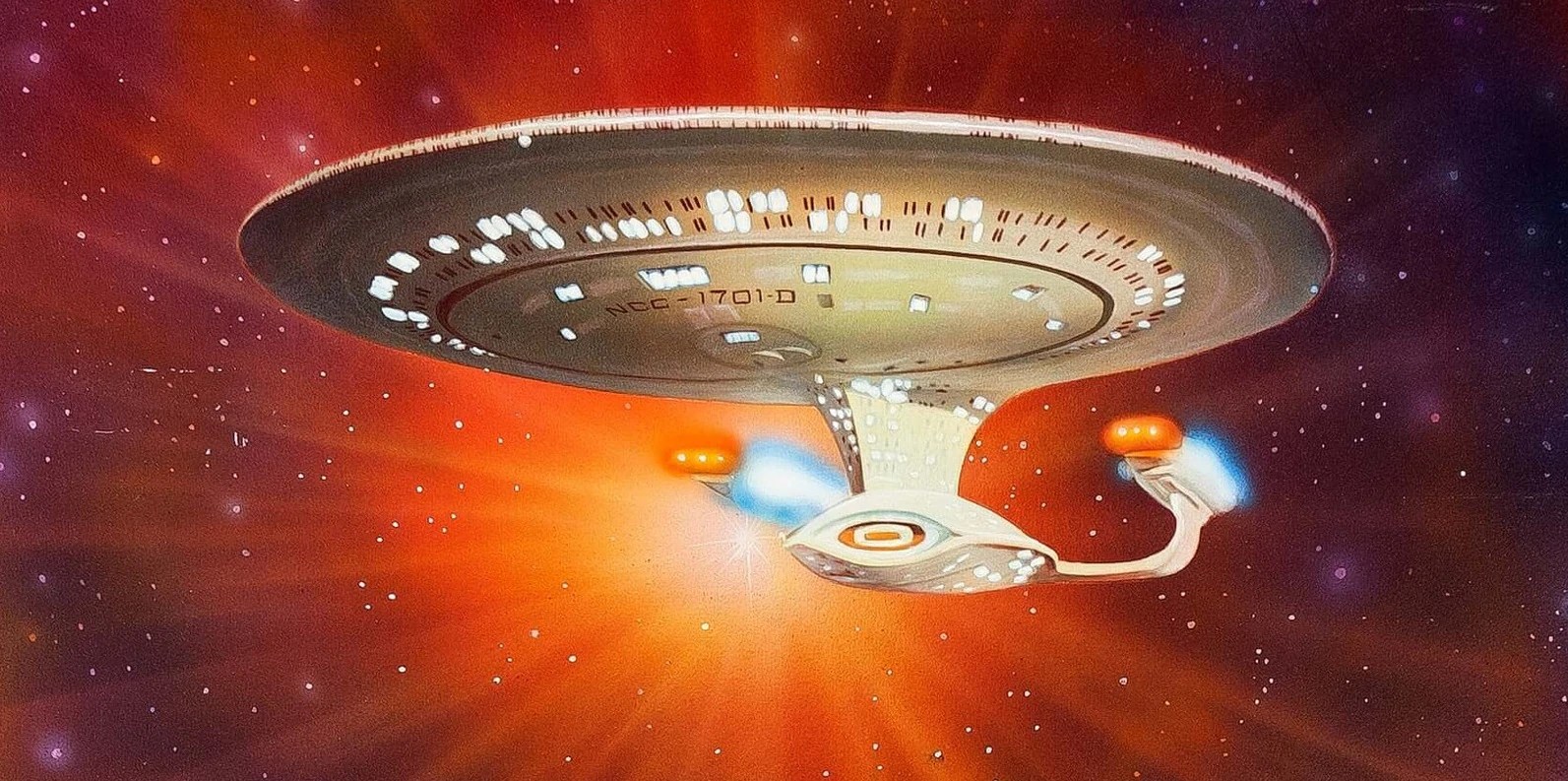
The answer arrived with NCC-1701-D.
Jean-Luc Picard’s Galaxy-class flagship was radically different from its predecessors. It was enormous, carrying not merely Starfleet officers but families and civilians. Its interiors suggested that deep-space exploration no longer needed to resemble military deployment.
This Enterprise wasn’t simply traveling through the Federation’s future.
It embodied its confidence.
The Enterprise-D expanded the Star Trek Enterprise Legacy for a new generation, proving that the name could thrive without Kirk in the center chair.
Picard commanded a civilization that believed diplomacy could prevent wars, reason could overcome prejudice and exploration remained valuable precisely because the unknown deserved to be understood rather than conquered.
The Enterprise-D encountered Q.
It made contact with the Borg.
It confronted Romulans, Klingon political instability, temporal anomalies and civilizations capable of challenging nearly every assumption its crew carried into space.
And through it all, Picard’s bridge became another generation’s image of Starfleet.
The Enterprise-D proved what Roddenberry’s decision to create The Next Generation had already suggested:
The mission could survive its original crew.
The name could too.
The Enterprise-E Faced a More Dangerous Galaxy
The destruction of the Enterprise-D in Star Trek Generations cleared the way for a very different vessel.
The Sovereign-class Enterprise-E was sleeker, faster and more battle-ready.
That wasn’t merely production design.
It reflected the changing universe around it.
The Federation of the late 24th century faced the Borg, growing political instability and conflicts that challenged the security Picard’s generation had once taken for granted.
In Star Trek: First Contact, the Enterprise-E followed the Borg into Earth’s past and protected the event that would ultimately transform humanity’s future: first contact with the Vulcans.
The symbolism is almost perfect.
Archer’s Enterprise helped build the Federation.
Kirk’s Enterprise explored what that Federation could become.
Picard’s Enterprise traveled backward through time to protect the moment that made all of it possible.
The lineage had become a circle.
From Enterprise-F to Enterprise-G
By the beginning of the 25th century, the name remained part of Starfleet tradition.
The Enterprise-F appeared during Frontier Day in 2401 as the vessel prepared for retirement. Its ceremonial farewell was interrupted by a Borg attack that transformed Starfleet’s celebration into catastrophe.
But another ship was already writing the next chapter.
The Titan-A, commanded during the crisis by Captain Liam Shaw and later Seven of Nine, helped expose the Changeling conspiracy and became central to the final confrontation with the Borg.
After the crisis, the Titan-A received a new name.
U.S.S. Enterprise NCC-1701-G.
Seven of Nine took the captain’s chair.
With Seven in the center chair, the Star Trek Enterprise Legacy entered another generation with a captain whose own journey embodied transformation and possibility.
Once again, Enterprise became inheritance.
Seven’s journey makes the choice especially meaningful. Once assimilated into the Borg Collective, she spent years rediscovering individuality aboard Voyager, struggled to find her place within the Federation, and ultimately became captain of the vessel carrying Starfleet’s most storied name.
The Enterprise had once defended humanity from the Borg.
Now someone who had survived the Borg commanded it.
That isn’t simply continuity.
That’s evolution.
More Than a Registry Number
What makes the Star Trek Enterprise Legacy remarkable isn’t the number of ships.
It’s what the name has come to represent.
Enterprise has been commanded by explorers, diplomats, warriors, scientists and survivors.
Its captains have approached command differently.
Archer was the pioneer.
Pike carries the burden of knowing his future.
Kirk trusted instinct.
Picard trusted diplomacy.
Seven of Nine carries a lifetime of learning what individuality and belonging actually mean.
The ships changed with them.
The NX-01 represented humanity reaching outward.
NCC-1701 represented exploration.
The Enterprise-A represented inheritance.
The Enterprise-C represented sacrifice.
The Enterprise-D represented Federation confidence.
The Enterprise-E represented resilience.
The Enterprise-G represents another generation taking possession of the mission.
And somewhere between them sits a larger truth about Star Trek.
The future isn’t built once.
It has to be inherited.
History Will Remember the Name Enterprise
There are other great ships in Star Trek.
Voyager crossed the Delta Quadrant and found its way home.
Defiant stood against the Dominion.
Discovery crossed centuries.
Protostar carried a new generation toward Starfleet.
Cerritos proved that some of the Federation’s most important work happens after the legendary ships leave.
Each expanded what a Star Trek starship could represent.
But Enterprise remains different.
When a new vessel receives that name, the audience immediately understands that something is being passed forward.
Not simply a registry.
Not simply a command.
A responsibility.
To explore.
To protect.
To question.
To discover.
To encounter people who appear different and resist the temptation to assume difference means danger.
To carry the Federation’s ideals into places where those ideals will inevitably be tested.
Sixty years ago, the Enterprise carried Star Trek into the unknown.
Six decades later, the ship has been destroyed, rebuilt, redesigned, renamed and reborn across centuries.
Yet the mission survives.
Captains leave.
Crews move on.
Starships eventually reach their final destination.
Then somewhere in a shipyard, another hull waits.
Another crew assembles.
Another captain approaches the center chair.
And eventually, someone looks toward the stars and gives the order.
Sixty years later, the Star Trek Enterprise Legacy continues because the name has never belonged exclusively to one ship, one captain or one generation.
Enterprise continues.
Continue the Voyage
← Previous: Space: The Final Frontier
Explore the Hub: Star Trek 60 | Celebrating 60 Years of the Final Frontier
Upcoming → The Captains of Star Trek | September 3
TheFilmGordon’s Star Trek 60 celebration continues throughout September with new stories exploring the voyages, captains, crews, starships, worlds, adversaries and ideas that have shaped the Final Frontier.