
by Tim Gordon
The Gene Roddenberry Star Trek Legacy Outlived Its Creator
Space: The Final Frontier begins with four words that have become inseparable from Star Trek. For sixty years, they have invited audiences aboard starships, across galaxies, through generations and toward a future originally imagined by creator Gene Roddenberry, whose extraordinary vision has now outlived him by more than three decades.
Space: the final frontier.
The words arrive like a door sliding open. Not loudly. Not urgently. Simply with promise.
For sixty years, the voyages of Federation starships have traced a constellation across our collective imagination. They have crossed light-years, but also eras, political tensions, social upheaval, technological revolutions and generations.
But the frontier has never existed solely at the edge of a star chart. It exists between fear and understanding. War and peace. Faith and reason. Isolation and community. The people we are and the people we might become.
And somewhere at the beginning of that extraordinary journey stood a television writer named Gene Roddenberry with an audacious proposition:
Perhaps humanity survives.
Perhaps we become better.
Perhaps the future belongs not to our divisions, but to our ability to overcome them.
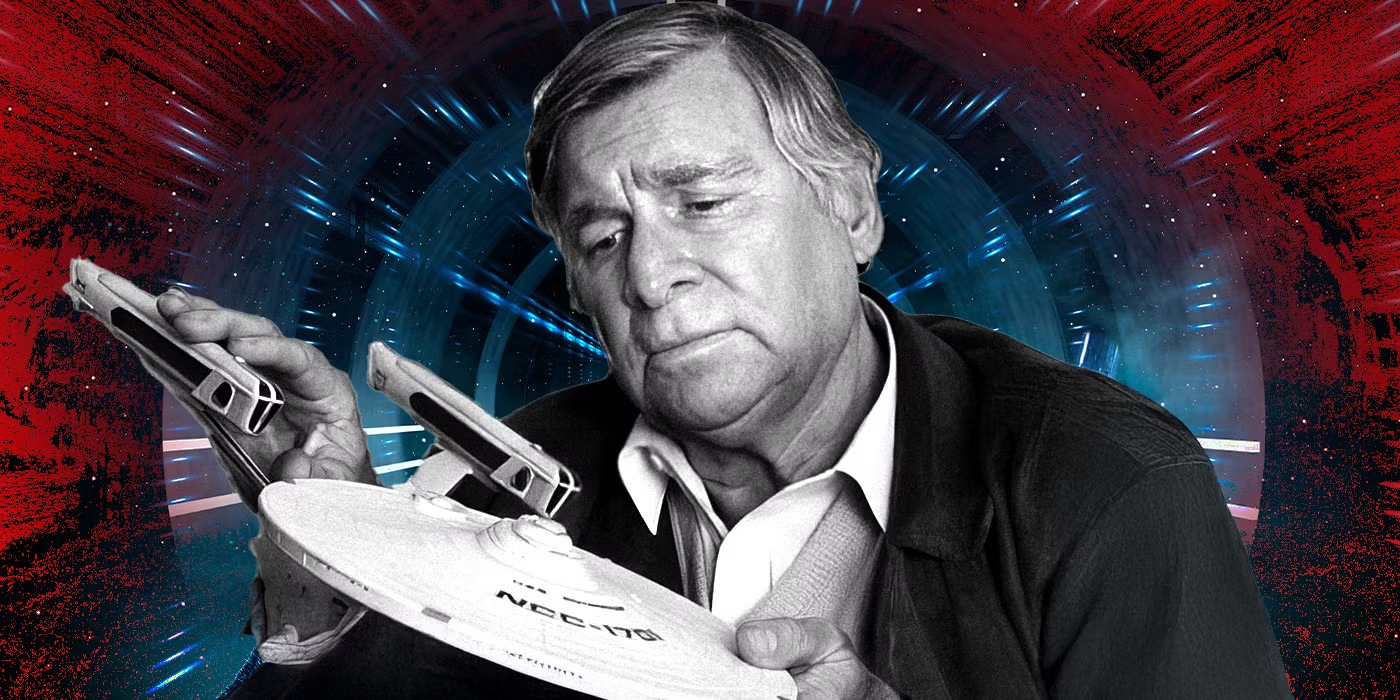
Gene Roddenberry Imagined More Than a Television Series
When Star Trek: The Original Series premiered on September 8, 1966, Roddenberry could not have known exactly what he had created.
There was Captain James T. Kirk in the center chair. Spock stood nearby, embodying the tension between logic and emotion. Leonard McCoy represented compassion and humanity. Nyota Uhura, Montgomery Scott, Hikaru Sulu and eventually Pavel Chekov completed a bridge populated by people whose very presence suggested something radical about the future.
Humanity had made it.
Not perfectly.
But together.
Roddenberry’s genius wasn’t simply imagining starships capable of traveling faster than light. Science fiction had dreamed about extraordinary machines long before the Enterprise left spacedock.
His greater invention was imagining the civilization that built the ship.
That philosophy was central to Gene Roddenberry’s vision for Star Trek, which sought to use science fiction not only to entertain audiences, but to challenge them to think about themselves and their future.
The future of Star Trek suggested humanity had survived many of the divisions threatening it in Roddenberry’s own time. Exploration had replaced conquest as an organizing principle. Scientific discovery had become a collective ambition. People from different cultures could occupy the same bridge without their differences becoming obstacles to cooperation.
The Enterprise embodied that argument. Its mission wasn’t primarily territorial expansion. It was discovery.
Again and again, Star Trek asked whether humanity could encounter difference without immediately attempting to dominate it. Sometimes the characters succeeded. Sometimes they failed spectacularly. But the aspiration mattered.
Human beings could become something better than the world of 1966 suggested they might.
Roddenberry created the architecture.
Space: The Final Frontier would become the invitation through which generations of storytellers entered that architecture and expanded what Roddenberry had begun.
Others would spend decades exploring its rooms.
The Mission Became Larger Than Its Creator
Gene Roddenberry died in 1991.
Star Trek did not.
By then, Star Trek: The Next Generation had already demonstrated that the universe could survive without Kirk, Spock, McCoy or even the original Enterprise. Jean-Luc Picard represented another interpretation of command. His Enterprise was larger, more sophisticated and carried families into deep space. The Federation appeared increasingly confident in itself.
But something more important had happened.
Star Trek had become an idea capable of being inherited.
That inheritance is central to Space: The Final Frontier, because the vision survived precisely by allowing new generations to reinterpret it.
After Roddenberry’s death, new storytellers began testing that idea in ways even its creator could not have anticipated.
Deep Space Nine asked what happened when Federation idealism encountered occupation, religion, political instability and prolonged war. Voyager stranded Kathryn Janeway and her crew 70,000 light-years from the institution whose principles they had sworn to uphold. Enterprise traveled backward to examine humanity before the Federation existed. Discovery eventually carried Michael Burnham centuries forward to a future where catastrophe had fractured the Federation itself.
Across those different eras, Space: The Final Frontier remained less a description of where Starfleet was going than a challenge to imagine what humanity might become along the way.
Each inherited a different version of the same fundamental question:
What are principles worth when following them becomes difficult?
That question allowed Star Trek to mature.
The Federation could no longer simply represent an ideal future. The franchise increasingly explored the sacrifices, compromises, institutions and individuals required to sustain one.
There is something profoundly hopeful about that evolution.
Roddenberry imagined humanity becoming better.
The storytellers who followed him asked how difficult remaining better might be.
Every Generation Found Its Own Frontier
The meaning of the frontier changed as Star Trek changed.
That evolution gives Space: The Final Frontier a different meaning depending upon which captain, century or corner of the Federation we are following.
For Kirk, it was frequently geographic. There was another planet, another civilization, another mystery beyond the edge of known space.
For Picard, the frontier became increasingly philosophical. What constitutes life? What rights belong to artificial intelligence? When does intervention become imperialism? What responsibilities accompany enormous technological power?
For Sisko, it became moral and spiritual. Can faith coexist with reason? Can a peaceful society survive war without surrendering its identity? Can one man simultaneously be Starfleet officer, father, leader and religious figure?
For Janeway, the frontier became isolation. Who are you when the institutions that defined you are impossibly far away?
For Burnham and Discovery, it eventually became restoration. What happens when the future itself needs to be rebuilt?
And now another generation of cadets inherits centuries of accumulated history in Starfleet Academy.
The ships changed with those questions.
Archer’s NX-01 represented humanity cautiously reaching beyond its neighborhood. Kirk’s Enterprise became the symbol of exploration itself. Picard’s Enterprise-D reflected a civilization confident enough in its future to bring families into deep space. Deep Space Nine remained stationary, forcing its characters to live with yesterday’s consequences. The Defiant reflected a Federation confronting enemies diplomacy alone couldn’t stop. Voyager became an island of Federation culture. Discovery carried that culture into a distant future where the institution itself needed reminding of what it once represented.
The technology became more sophisticated.
But the real evolution was philosophical.
Every vessel became another interpretation of the same mission.
Through each of them, Space: The Final Frontier became a promise carried from one generation of explorers to the next.

Star Trek Became a Conversation Across Generations
Perhaps the greatest reward of revisiting Star Trek sixty years later is discovering how often its stories speak to one another.
A character introduced decades earlier can suddenly illuminate a story set centuries later. An old conflict becomes history. History becomes mythology. Mythology becomes something another generation must interpret.
The Dax symbiont allows memory and identity to travel across lifetimes. Benjamin Sisko’s experiences on Deep Space Nine can continue resonating long after his story seemingly ended. The catastrophic Burn encountered by Discovery reshapes the Federation inherited by another generation. Christopher Pike now occupies the Enterprise while audiences simultaneously know that James T. Kirk waits somewhere beyond the horizon.
Past, present and future continuously overlap.
That conversation gives Space: The Final Frontier its remarkable longevity, allowing stories separated by decades of television to speak to one another across centuries of fictional history.
That interconnectedness has transformed Star Trek into something Roddenberry could never have completely mapped in 1966.
He planted the seed.
Generations built the forest.
And despite all those planets, starships, aliens and technologies, Star Trek has never really been about space.
The future has always been a way of talking about the present.
Race. War. Faith. Capitalism. Colonialism. Gender. Identity. Artificial intelligence. Authoritarianism. Family. Grief. Diplomacy. Personhood. Belonging.
Star Trek places those questions among the stars because distance sometimes allows us to see ourselves more clearly.
The alien across the viewscreen is frequently us.
The strange new world is frequently ours.
And the civilization being examined is frequently the one watching from home.
Gene Roddenberry’s Greatest Creation Was Possibility
Roddenberry wasn’t perfect, and neither was the universe he created.
Nor should celebrating his vision require pretending otherwise.
The power of Star Trek is that it became larger than any single person. Writers, producers, directors, designers, actors, craftspeople and generations of audiences have expanded, challenged, reconsidered and occasionally contradicted the original vision.
That is what living ideas do.
But sixty years later, Roddenberry’s central proposition remains astonishingly resilient.
Humanity has a future.
Not because technology will save us. Not because conflict will disappear. Not because people will suddenly become perfect.
We have a future because we might learn.
We might cooperate.
We might become curious about people different from ourselves rather than afraid of them.
We might decide exploration is more valuable than conquest.
We might discover that progress isn’t something civilization achieves once. It is something each generation must choose again.
Sixty years after the Enterprise first appeared on television screens, thirteen television series have carried that proposition across centuries. Films have expanded and reimagined it. Generations of captains have occupied the center chair. Crews have changed. Ships have evolved. The Federation has risen, stumbled, fractured, endured and rebuilt.
And Gene Roddenberry’s vision has outlived him.
Perhaps that is the clearest measure of its power.
He imagined a future that other people wanted to continue imagining.
A future large enough for Kirk and Picard. Sisko and Janeway. Archer and Burnham. Pike and generations still to come.
A future capable of being challenged without being abandoned.
Space: The Final Frontier
The Final Frontier was never simply space.
It was possibility.
The possibility that curiosity might defeat fear. That understanding might defeat prejudice. That cooperation might defeat division. That humanity’s greatest achievements might still be ahead of us.
Those possibilities remain unfinished.
So does the mission.
There will always be another horizon. Another question. Another strange new world. Another generation willing to go.
The voyages continue.
And sixty years later, Gene Roddenberry’s invitation remains open:
Imagine better.
Continue the Voyage
Explore the Hub: Star Trek 60 | Celebrating 60 Years of the Final Frontier
Upcoming → The Enterprise Legacy | September 2
TheFilmGordon’s Star Trek 60 celebration continues throughout September with new stories exploring the voyages, captains, crews, starships, worlds, adversaries and ideas that have shaped the Final Frontier.
Discover more from FilmGordon
Subscribe to get the latest posts sent to your email.


