by Tim Gordon
Deep Space Nine Mysteries reach far beyond the Bajoran wormhole, connecting Benjamin Sisko, the Prophets, Odo, the Dominion and Bajor to questions that transformed Star Trek into something deeper, stranger and more spiritually complex.
The Mysteries of Deep Space Nine Changed the Final Frontier
Star Trek: Deep Space Nine began with a mystery.
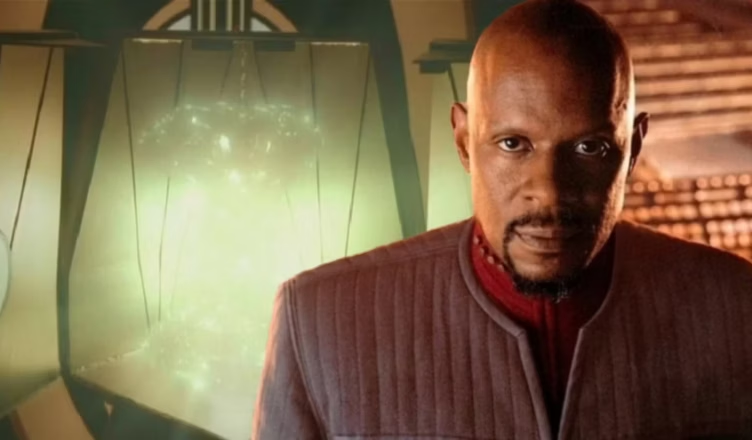
Benjamin Sisko entered the Bajoran wormhole expecting to encounter an unexplained phenomenon. Instead, he met beings who existed outside linear time and discovered that the Bajorans had known them for centuries as the Prophets.
To Starfleet, they were aliens.
To Bajor, they were gods.
And to the Prophets, Sisko was something neither Starfleet nor Sisko himself completely understood.
He was the Emissary.
That encounter established one of the fundamental differences between Deep Space Nine and the Star Trek that preceded it. The series wasn’t merely interested in exploring strange new worlds. It wanted to explore things its characters couldn’t easily explain.
Faith. Destiny. Identity. Memory. Time.
And whether understanding something scientifically necessarily means understanding what it means.
The official Star Trek: Deep Space Nine archive traces a seven-season story in which those questions gradually connected Sisko, Bajor, the Prophets, the Dominion and the station itself.

Sisko and the Prophets Made Faith Part of the Mystery
The greatest of the Deep Space Nine Mysteries was ultimately Benjamin Sisko himself.
He arrived believing his life had been shaped by choices he understood. He was a Starfleet officer, widower and father still carrying the trauma of Jennifer’s death at Wolf 359.
Then the Prophets changed the terms of his existence.
The Bajorans believed Sisko’s arrival had been foretold. Kai Opaka recognized him as the Emissary, placing a spiritual responsibility upon a man who had never asked for one.
Initially, Sisko resisted.
Eventually, resistance became acceptance.
But the series gradually revealed something more unsettling. Sisko’s relationship with the Prophets wasn’t accidental. His birth, his mother Sarah and his arrival at Bajor were connected to forces operating beyond his understanding of linear time.
Was he chosen?
Was he created for a purpose?
How much of his life actually belonged to him?
Those questions made Sisko unlike any Star Trek captain before him.
Kirk explored the unknown.
Picard attempted to understand it.
Sisko discovered that he was part of it.
The Prophets made that distinction even more fascinating because Deep Space Nine never forced audiences to choose between science and faith. Starfleet could describe them as non-corporeal beings inhabiting the wormhole. Bajor could worship them as gods.
Both explanations could coexist.
The Prophets, their Orbs and eventually the Pah-wraiths allowed Deep Space Nine to explore spirituality without simply waiting for science to correct it.
Odo and Dax Turned Identity Into a Question
Some of the most powerful Deep Space Nine Mysteries weren’t about distant civilizations. They were about the people living on the station.
For years, Odo knew almost nothing about his origins. He was a shapeshifter surrounded by solids, able to imitate their forms without ever completely becoming one of them.
He wanted to know where he belonged.
Then he found his people.
And the answer was terrifying.
The Founders ruled the Dominion, transforming their fear of solids into an ideology of control. Odo’s personal search for identity suddenly became inseparable from the greatest political threat facing the Federation.
Finding his people didn’t mean he had to become them.
Jadzia Dax approached identity from another direction. She carried the memories of previous Trill hosts, including Curzon Dax, Benjamin Sisko’s former friend and mentor.
Jadzia was herself, but she remembered lives she hadn’t personally lived.
Sisko’s nickname for her, “Old Man,” captured that beautiful contradiction. He saw Jadzia standing before him while remembering the friend whose memories she carried.
After Jadzia’s death, Ezri Dax complicated the question again.
Dax remained.
The person carrying Dax changed.
Odo and Dax therefore approached the same mystery from opposite directions.
How much of who we are comes from where we came from, and how much do we choose for ourselves?

Cardassia and the Dominion Made Truth More Complicated
Other mysteries were political.
Elim Garak embodied uncertainty. He was a tailor, former intelligence operative, exile, liar, patriot and survivor whose stories frequently contradicted one another.
Through Garak, Deep Space Nine transformed Cardassia from an enemy civilization into something audiences could understand from within.
Understanding, however, wasn’t absolution.
Gul Dukat desperately wanted history to remember him as something better than an oppressor. He wanted Bajorans to acknowledge what he considered his mercy while refusing to accept what occupation had actually meant to the people living beneath it.
The series refused him the redemption he believed he deserved.
Then the Dominion War expanded those questions to the Federation itself.
The Dominion represented control as political philosophy. The Founders believed order justified domination.
But war revealed uncomfortable contradictions inside the Federation too.
Section 31 claimed that paradise sometimes required people willing to violate its principles in secret.
Sisko confronted his own version of that argument in “In the Pale Moonlight,” when bringing the Romulans into the war required compromises he could never comfortably reconcile with the officer he believed himself to be.
Suddenly the mystery wasn’t whether the Federation was good.
It was whether good institutions could survive existential threats without becoming something else.
How much darkness can a society tolerate in the name of protecting the light?
Deep Space Nine Never Solved Everything
That may be why the Deep Space Nine Mysteries remain so compelling.
The series gave audiences answers.
We learned where Odo came from.
We discovered what waited beyond the wormhole.
We understood more about the Prophets.
We learned why Sisko’s life was intertwined with them.
We watched the Dominion emerge from rumor into terrifying reality.
But the answers rarely made the universe simpler.
They made it larger.
Science didn’t erase faith.
Discovering your origins didn’t determine your identity.
Understanding an enemy didn’t absolve them.
Winning a war didn’t make every action taken during it moral.
Knowing more didn’t necessarily produce certainty.
The station sat beside a wormhole connecting distant regions of the galaxy, but the more important connections were between ideas.
Science and faith.
Duty and destiny.
Identity and memory.
Justice and vengeance.
Security and freedom.
Principle and survival.
And nobody embodied those contradictions more completely than the man who arrived at Deep Space 9 as a reluctant commander and eventually understood that Starfleet wasn’t the only force shaping his destiny.
Benjamin Sisko was a captain.
A father.
A widower.
A Starfleet officer.
And the Emissary of the Prophets.
The greatest mystery of Deep Space Nine was always leading back to him.
Continue the Voyage
← Previous: Deep Space Nine: The Federation on the Frontier
Explore the Hub: Star Trek 60 | Celebrating 60 Years of the Final Frontier
Upcoming → Benjamin Sisko: Captain, Emissary, Legend | September 13
TheFilmGordon’s Star Trek 60 celebration continues throughout September with new stories exploring the voyages, captains, crews, starships, worlds, adversaries and ideas that have shaped the Final Frontier.
Discover more from FilmGordon
Subscribe to get the latest posts sent to your email.