by Tim Gordon
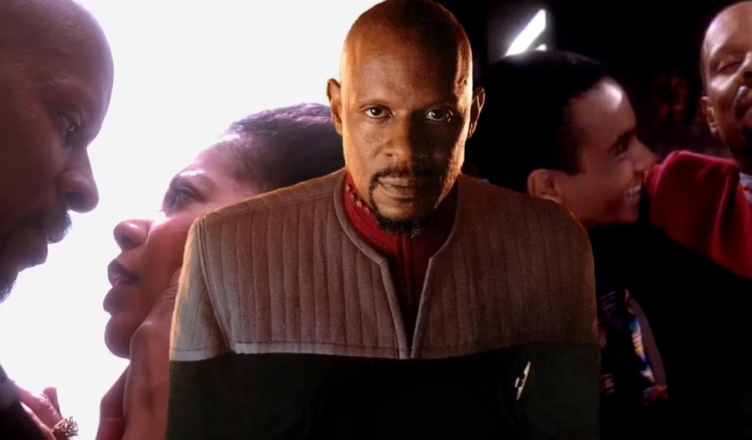
Benjamin Sisko entered Star Trek: Deep Space Nine as a grieving father who wasn’t certain he wanted to remain in Starfleet. Seven seasons later, he had become a captain, wartime commander and religious figure whose extraordinary journey challenged almost every assumption about what a Star Trek leader could be.
Sisko didn’t simply command the frontier.
He became part of its history.
Benjamin Sisko Was Unlike Any Captain Before Him
When audiences first met Benjamin Sisko in “Emissary,” he wasn’t sitting confidently in the center chair of a starship.
He was broken.
His wife Jennifer had been killed at the Battle of Wolf 359, leaving Sisko to raise their son Jake while carrying grief he had never truly confronted. His first meeting with Jean-Luc Picard made that trauma impossible to ignore. To audiences, Picard was one of Star Trek’s great heroes. To Sisko, he was also the face of Locutus, the Borg responsible for the attack that destroyed his family.
That distinction immediately separated Sisko from Kirk and Picard.
He wasn’t introduced as Captain Benjamin Sisko. He arrived on Deep Space 9 as a commander, assigned to oversee a damaged former Cardassian station beside a recovering Bajor.
Then he discovered the wormhole.
Inside were beings the Bajorans worshipped as the Prophets. They didn’t understand linear existence, and Sisko couldn’t understand why they kept returning him to the moment of Jennifer’s death.
Eventually, he understood.
He wasn’t living in the present.
Part of him was still living there.
Before Sisko could lead Bajor or Deep Space 9, he had to begin moving forward himself.
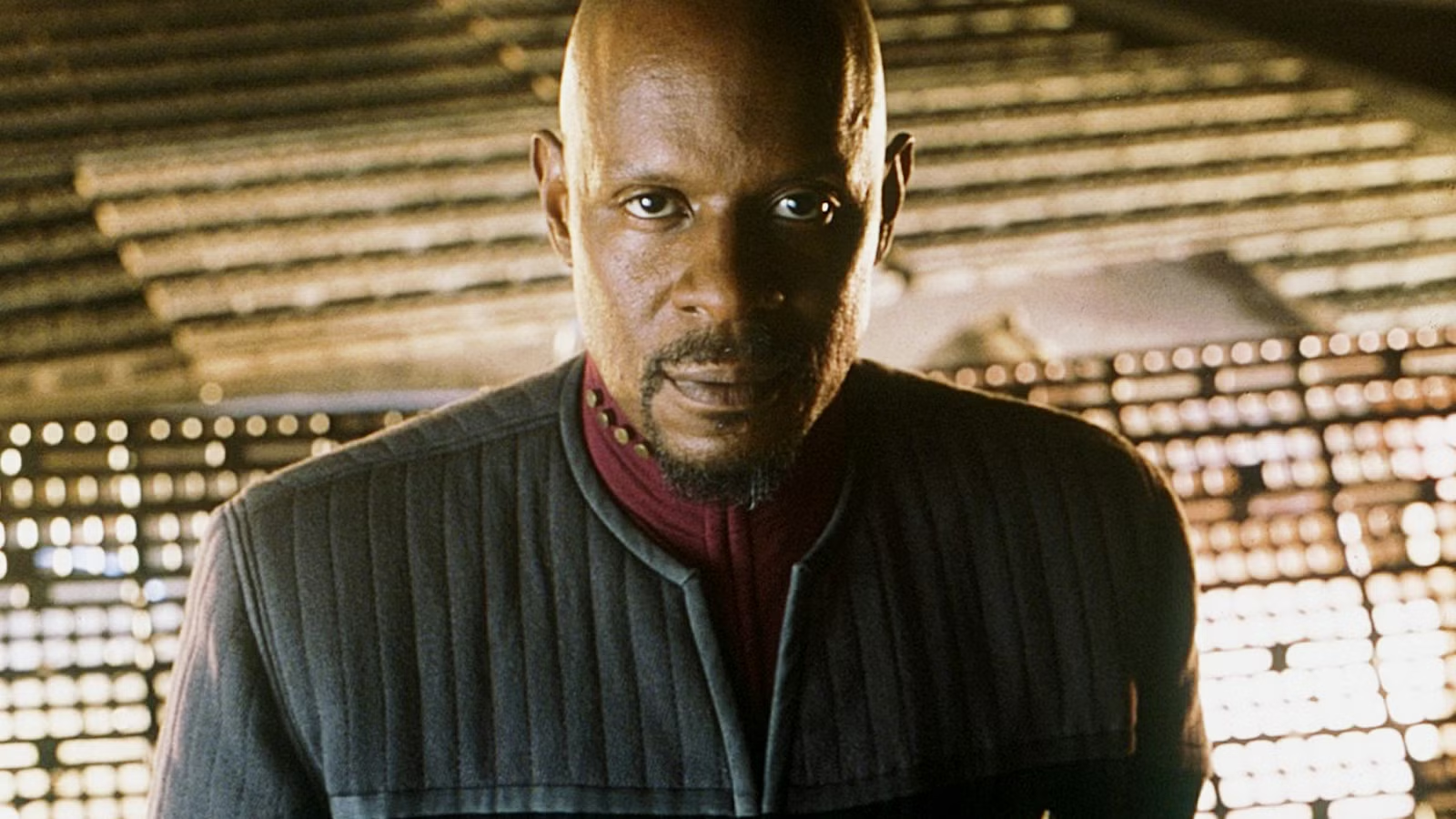
Captain Sisko Was a Commander, Father and Builder
Sisko’s evolution didn’t happen in isolation.
Jake was central to it.
Their relationship gave Deep Space Nine something unusually intimate. Sisko wasn’t simply an officer who happened to have a child. Fatherhood was fundamental to his identity.
He cooked for Jake. Worried about him. Encouraged his writing. Disagreed with his choices. Tried to protect him while gradually recognizing that his son had to build a life beyond his father’s expectations.
That bond reached its emotional peak in Season 4’s “The Visitor,” one of Deep Space Nine’s most enduring episodes. After an accident apparently kills Benjamin, Jake spends decades unable to let his father go, eventually discovering that Sisko remains trapped outside normal time and periodically reappears in his life.
Jake grows older. He becomes a successful writer. He marries. But the loss of his father becomes the gravitational center of his existence, eventually consuming the future Benjamin had wanted him to build.
What makes “The Visitor” so powerful isn’t simply Jake’s grief. It is the depth of his enduring love for his father. Jake devotes much of his life to finding a way to bring Benjamin home, while Sisko, during their brief reunions, desperately wants his son to stop sacrificing his own life for him.
The episode transforms their relationship into something larger than ordinary father-son affection. Benjamin spends the series trying to prepare Jake for a life without him. “The Visitor” reveals that Jake cannot imagine that life without his father.
And when an elderly Jake finally discovers a way to break the temporal cycle, his final act isn’t about preserving his own life. It is about giving his father his life back.
The timeline resets.
Benjamin returns.
Jake gets his father back.
And Sisko awakens carrying the memory of just how completely his son loved him.
The Sisko family also carried something culturally significant into Star Trek. Benjamin, Jake and Joseph Sisko presented generations of a Black family whose relationships were rooted in affection, history, food, responsibility and love.
Sisko’s life expanded beyond Starfleet in other ways too.
He loved baseball.
He cooked.
He eventually built a relationship with Kasidy Yates.
He could be warm, funny and deeply affectionate, but none of those qualities diminished his authority.
Instead, they enlarged him.
When Sisko was promoted to captain, the fourth pip didn’t suddenly make him a leader.
It recognized the leader he had already become.
The Emissary Changed What Starfleet Command Could Mean
The role Sisko could never completely separate from his command was the one Starfleet hadn’t given him.
Emissary of the Prophets.
At first, he regarded the title with skepticism. Starfleet officers were explorers, scientists and diplomats. They weren’t supposed to become religious figures.
Bajor had other ideas.
Over time, Benjamin Sisko stopped treating his role as Emissary as an inconvenience and began accepting that it carried responsibilities Starfleet couldn’t define for him.
That created one of the richest tensions in the series.
What happens when duty to Starfleet conflicts with responsibility to a people who believe you were sent by their gods?
Sisko increasingly occupied both worlds.
He remained a Starfleet officer grounded in duty, reason and service. But he also experienced visions, communicated with the Prophets and eventually understood that his relationship with them stretched back further than he imagined.
His life wasn’t simply intersecting with Bajoran history.
It had become part of it.
That didn’t make Sisko less rational.
It made his universe larger.
War Revealed the Captain Sisko Had Become
Then came the Dominion.
The station that had once represented Bajor’s uncertain future became one of the most strategically important locations in the Alpha Quadrant, and Captain Sisko became a wartime commander.
The transformation wasn’t painless.
Sisko commanded fleets, planned military operations, endured casualties and made decisions that the younger officer who arrived at Deep Space 9 might once have considered unthinkable.
Few episodes capture that evolution more powerfully than “In the Pale Moonlight.”
Facing catastrophic Federation losses, Sisko participates in a plan with Garak to bring the Romulan Empire into the war.
The plan succeeds.
Its morality does not become any easier to live with.
Sisko’s final admission that he can live with what happened remains powerful because the series doesn’t present it as triumph. Victory and righteousness aren’t always the same thing.
The Dominion War repeatedly forced Sisko to confront that distinction.
He could inspire people.
He could command them.
He could send them into battle.
And sometimes he had to live with what returning home required.
That made Sisko one of the most complicated captains in Star Trek history.

Benjamin Sisko Became Larger Than the Uniform
By the final season, the different identities surrounding Benjamin Sisko could no longer be separated.
Captain.
Father.
Husband.
Commander.
Emissary.
Each demanded something different from him.
His relationship with Kasidy offered the possibility of a future beyond war. Jake remained the emotional center of his life. Starfleet still required his service. Bajor still regarded him as the Emissary.
And the Prophets were still waiting.
His final confrontation with Dukat and the Pah-wraiths brought the spiritual story that began in “Emissary” full circle. Sisko ultimately joined the Prophets in the Celestial Temple, leaving behind the people he loved without suggesting that his human relationships had somehow become unimportant.
Quite the opposite.
His promise to Kasidy that he would return transformed his ending from death into absence.
Sisko’s story remained unfinished.
That feels appropriate for a character whose entire journey challenged the idea that time must move in a straight line.
Captain. Emissary. Legend.
Benjamin Sisko’s legacy isn’t contained in any single title.
He became a captain without beginning as one.
He became a religious figure without seeking faith.
He became a wartime commander despite being sent to help rebuild a society emerging from occupation.
He became one of Starfleet’s most consequential leaders while remaining unmistakably a father, son, partner and friend.
That combination made him different.
Kirk showed us the captain as explorer.
Picard showed us the captain as philosopher and diplomat.
Sisko showed us what happened when the captain could no longer stand apart from the history unfolding around him.
He had to choose.
He had to compromise.
He had to believe.
He had to live with consequences.
And sometimes he had to accept that there were forces in the universe he couldn’t command from the center chair.
The man who arrived at Deep Space 9 was still living at Wolf 359.
The man who left it had helped save the Alpha Quadrant, changed the destiny of Bajor and discovered that his own life belonged to a story stretching beyond linear time.
Benjamin Sisko was a captain.
Benjamin Sisko was the Emissary.
Benjamin Sisko became a legend.
Continue the Voyage
← Previous: The Mysteries of Deep Space Nine
Explore the Hub: Star Trek 60 | Celebrating 60 Years of the Final Frontier
Upcoming → Voyager: The Federation in Isolation | September 14
TheFilmGordon’s Star Trek 60 celebration continues throughout September with new stories exploring the voyages, captains, crews, starships, worlds, adversaries and ideas that have shaped the Final Frontier.
Discover more from FilmGordon
Subscribe to get the latest posts sent to your email.