by Tim Gordon
Star Trek: Deep Space Nine took the optimistic future inherited from The Next Generation and placed it somewhere that optimism could no longer remain theoretical.
Deep Space Nine Changed What the Final Frontier Could Be
When Star Trek: Deep Space Nine premiered in 1993, the franchise made a decision that initially seemed almost contradictory.
It stopped moving.
There was no Enterprise carrying the crew toward another strange new world each week. Instead, Commander Benjamin Sisko and his officers inherited a battered Cardassian space station orbiting Bajor, a planet emerging from decades of brutal occupation.
The station had once been called Terok Nor.
Now it was Deep Space 9.
Then the discovery of a stable wormhole changed everything.
Suddenly, this damaged outpost became one of the most strategically important locations in the quadrant, a gateway to the unexplored Gamma Quadrant and eventually the front line of a conflict that would test the Federation itself.
The frontier had changed.
Instead of asking what Starfleet might discover somewhere else, Deep Space Nine increasingly asked what happens when everyone comes to you.
The official Star Trek: Deep Space Nine series archive follows the station’s seven-season journey from Bajor’s fragile recovery through the Dominion War.

Sisko, Kira and a Station Full of Contradictions
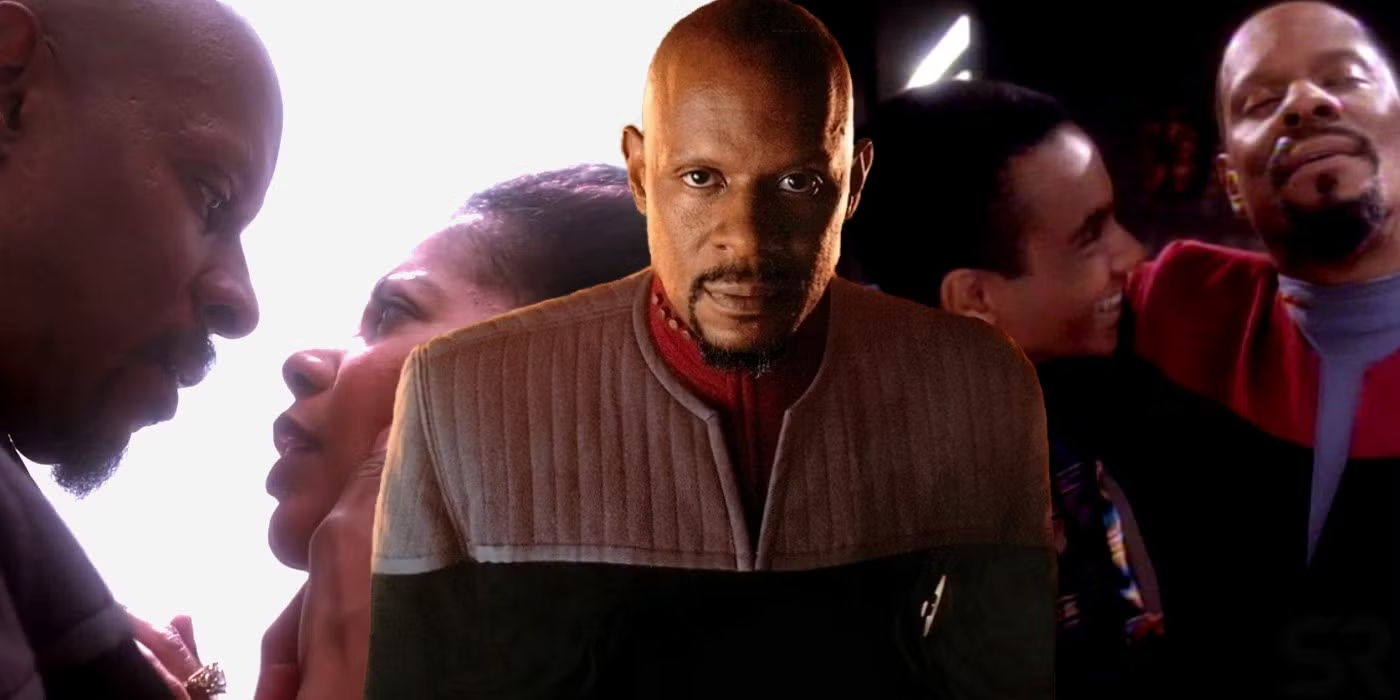
At the center was Benjamin Sisko, introduced not as a captain but as a commander carrying grief.
His wife Jennifer had been killed during the Battle of Wolf 359, where the Borg, led by an assimilated Jean-Luc Picard, devastated Starfleet.
That history immediately complicated the comfortable continuity between The Next Generation and its successor.
Picard was a hero to audiences.
To Sisko, Picard wore the face of the man responsible for his wife’s death.
And Sisko’s assignment brought another complication almost immediately.
The Bajorans identified him as the Emissary of the Prophets.
A Starfleet officer committed to a largely secular institution suddenly became a religious figure within a culture whose beliefs were inseparable from its history, politics and survival.
Beside him stood Kira Nerys, a former Bajoran resistance fighter who had spent much of her life fighting the Cardassian occupation.
Kira wasn’t a Starfleet officer. She didn’t automatically accept Federation assumptions about how Bajor should rebuild. Her anger, faith and memories of occupation gave the series a perspective Starfleet alone could never provide.
Their relationship became one of the show’s essential tensions.
Sisko represented the Federation.
Kira represented a people deciding whether the Federation deserved their trust.
Neither perspective could simply absorb the other.
Star Trek: Deep Space Nine built much of its identity around that tension, allowing Starfleet ideals and Bajoran experience to challenge one another rather than forcing either perspective to disappear.
Deep Space 9 Became a Place Where Everyone Had to Live Together
The station’s greatest storytelling advantage was permanence.
The Enterprise could encounter a civilization, resolve a crisis and warp away.
Deep Space 9 couldn’t.
The consequences stayed.
So did the people.
Odo, the station’s shape-shifting security chief, searched for the truth about his origins while gradually discovering that his own people posed one of the greatest threats the Federation had ever encountered.
Jadzia Dax carried multiple lifetimes within her, connecting identity to memory in a way few other Star Trek characters could.
Julian Bashir arrived as an ambitious young doctor and gradually became something considerably more complicated.
Miles O’Brien, carried over from The Next Generation, gave the station an essential working-class center.
Quark transformed the Ferengi from caricatures into people with families, traditions, contradictions and their own view of Federation economics.
And Garak, ostensibly a simple Cardassian tailor, became one of the franchise’s great embodiments of ambiguity.
Nobody existed in isolation.
Relationships accumulated history.
Arguments didn’t necessarily disappear when an episode ended.
Choices returned with consequences.
For perhaps the first time, Star Trek had built a place that remembered.
Star Trek: Deep Space Nine turned that permanence into one of its greatest strengths, allowing relationships, rivalries and political decisions to accumulate consequences across seven seasons.
Bajor Made Faith Part of the Star Trek Conversation
Bajor fundamentally changed the kinds of questions Star Trek could ask.
The Federation frequently approached the universe through science and reason.
The Bajorans approached part of that same universe through faith.
The beings Starfleet understood as aliens living inside the wormhole were the Prophets to Bajor.
Both descriptions could be true depending on who was speaking.
Sisko couldn’t dismiss Bajoran belief simply because Starfleet possessed another vocabulary for explaining it. His relationship with the Prophets became increasingly personal, eventually making his identity as Emissary impossible to separate from his role as a Starfleet officer.
Kira’s faith was equally important.
Her beliefs weren’t treated merely as superstition waiting for science to correct them. They existed alongside her politics, trauma, morality and understanding of herself.
That gave Deep Space Nine a distinctive place within the franchise.
It wasn’t asking audiences to choose between science and faith.
Star Trek: Deep Space Nine instead allowed science and spirituality to occupy the same universe, sometimes offering different languages for experiences neither side completely understood.
It was asking whether people with fundamentally different explanations of existence could still understand one another.
The Dominion War Put the Federation on Trial
Eventually, the frontier became a battlefield.
The discovery of the Dominion transformed Deep Space Nine from a story about rebuilding and coexistence into something larger and darker.
The Dominion wasn’t merely another enemy fleet.
It was a political order built around control.
The Founders imposed stability through hierarchy and obedience, with the genetically engineered Vorta administering their empire and the Jem’Hadar enforcing it.
The Federation suddenly faced an opponent powerful enough to threaten its existence.
And war changed the questions.
What happens to principles when survival is uncertain?
How far can a democratic society go to protect itself before it begins resembling what it opposes?
Can deception become moral if it saves lives?
Can institutions built for exploration survive becoming institutions of war?
Episodes such as “In the Pale Moonlight” forced those questions directly onto Sisko.
“The Siege of AR-558” stripped away the abstraction of interstellar conflict and showed the physical and psychological cost paid by the people fighting it.
The existence of Section 31 revealed that even within the Federation, some believed its ideals could only survive because others were willing to violate them in secret.
Deep Space Nine didn’t destroy Roddenberry’s optimistic future.
It did something more interesting.
It stress-tested it.
Star Trek: Deep Space Nine made that test increasingly difficult by asking what Federation principles were worth when adhering to them could carry an extraordinary cost.
The Federation Looked Different From the Frontier
That distinction is why Star Trek: Deep Space Nine has become increasingly central to understanding the franchise.
The series didn’t argue that Federation ideals were naïve.
It argued that ideals only reveal their value when keeping them becomes difficult.
Sisko sometimes compromised.
Kira carried scars that diplomacy couldn’t erase.
Odo discovered terrible truths about his own people.
Worf, after joining the station, found himself repeatedly caught between Klingon identity and Starfleet responsibility.
Bajor had to determine its future without simply becoming whatever the Federation wanted it to be.
Even the Dominion War eventually required former enemies to cooperate.
Nobody emerged untouched.
Yet the Federation survived.
Not because its principles were never violated, but because the violations mattered.
The moral discomfort mattered.
The arguments mattered.
The possibility of becoming something worse mattered.
Deep Space Nine understood that optimism without pressure is merely aspiration.
Optimism under pressure becomes a choice.
The Federation on the Frontier
For seven seasons, Deep Space Nine transformed a former Cardassian mining station into one of the richest crossroads in the Star Trek universe.
Bajorans prayed there.
Ferengi conducted business there.
Cardassians returned to it.
Klingons fought beside it.
Starfleet defended it.
Travelers crossed through its wormhole toward an unexplored quadrant.
And Benjamin Sisko gradually discovered that his place there involved something larger than the assignment Starfleet had given him.
The station couldn’t simply fly away from its problems.
That changed Star Trek.
Star Trek: Deep Space Nine made consequences part of the architecture of the series, transforming the station into a place where yesterday’s decisions could reshape tomorrow’s alliances.
Stories became more serialized.
Politics accumulated consequences.
Secondary characters developed lives extending far beyond their original functions.
Enemies became allies.
Allies became compromised.
Faith and science occupied the same room.
War forced utopian principles into uncomfortable territory.
The Final Frontier was no longer merely somewhere beyond the next star.
Sometimes it was a border.
Sometimes it was a battlefield.
Sometimes it was a community trying to survive its own history.
And sometimes it was a battered space station standing beside a wormhole, forcing the Federation to discover what its ideals actually meant.
Deep Space Nine didn’t abandon the future Star Trek had imagined.
It made that future prove itself.
Continue the Voyage
← Previous: The Next Generation: A New Enterprise for a New Generation
Explore the Hub: Star Trek 60 | Celebrating 60 Years of the Final Frontier
Upcoming → The Mysteries of Deep Space Nine | September 12
TheFilmGordon’s Star Trek 60 celebration continues throughout September with new stories exploring the voyages, captains, crews, starships, worlds, adversaries and ideas that have shaped the Final Frontier.