by Tim Gordon
Star Trek: Enterprise traveled backward to move the franchise forward, returning to a time before the Federation, before the Prime Directive and before Starfleet officers could rely on generations of experience to tell them how humanity should behave among the stars.
Captain Jonathan Archer and the crew of the NX-01 weren’t inheriting the Federation.
They were helping create the conditions that would make it possible.
Enterprise Went Back to the Beginning
When Enterprise premiered in 2001, audiences already knew what humanity would eventually become.
Kirk represented a mature Federation exploring the galaxy. Picard commanded during an era when its ideals appeared firmly established. Sisko tested those ideals through war, while Janeway carried them across the Delta Quadrant.
Star Trek: Enterprise removed that certainty.
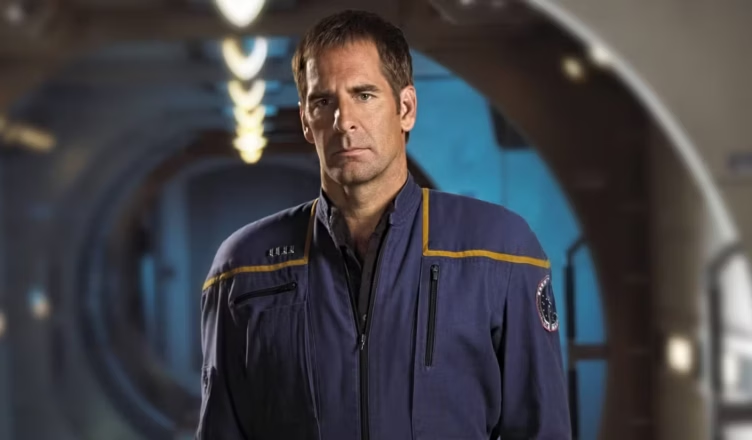
Set in the 22nd century, the series introduced humanity still taking its first uncertain steps into deep space. The Enterprise NX-01 was Earth’s first Warp 5 starship, commanded by Jonathan Archer at a moment when humans possessed ambition that often exceeded their experience.
There was no Federation to provide diplomatic protocols.
No Prime Directive to define the limits of interference.
No vast Starfleet infrastructure waiting nearby.
Humanity was learning how to become the civilization later generations would take for granted.
Star Trek: Enterprise made that uncertainty central to its story, showing humanity learning through mistakes that later generations of Starfleet officers would inherit as experience.
That made every first contact more consequential.
Archer and his crew weren’t simply exploring strange new worlds.
They were learning how humanity should behave when it reached them.

Archer Had to Learn What Future Captains Would Inherit
Jonathan Archer began his mission with understandable confidence in humanity’s readiness to explore.
He also carried resentment.
The Vulcans had spent decades advising Earth to proceed cautiously, and Archer believed their influence had slowed humanity’s progress. T’Pol, initially assigned to the Enterprise as a Vulcan observer, embodied much of that frustration.
But the relationship changed.
Archer discovered that enthusiasm wasn’t the same as preparation. T’Pol learned that humanity’s unpredictability could also produce courage, loyalty and imagination.
Their evolving respect became one of the foundations of the series.
The crew around them was equally important. Trip Tucker represented humanity’s engineering ingenuity and emotional openness. Hoshi Sato confronted the enormous challenge of communicating with species humanity had never encountered. Malcolm Reed, Travis Mayweather and Phlox helped turn the NX-01 into something larger than an experimental spacecraft.
Together, they became a prototype for the Starfleet crews that would follow.
And Archer became a prototype for their captains.
Star Trek: Enterprise allowed audiences to watch that model of command being built in real time, before generations of tradition could tell Archer what a Starfleet captain was supposed to be.
He made mistakes.
Future captains would inherit the lessons.
The Xindi Crisis Changed Humanity’s First Voyage
The mission changed dramatically when Earth was attacked by the Xindi.
Suddenly exploration became survival.
Archer took the Enterprise into the Delphic Expanse, pursuing a threat capable of destroying Earth while confronting choices that challenged the optimism with which his mission had begun.
The Xindi arc pushed Star Trek: Enterprise into darker territory.
Archer became more willing to compromise. He deceived adversaries, crossed ethical boundaries and increasingly carried the weight of an entire planet’s survival.
The experience anticipated questions Deep Space Nine would later confront during the Dominion War, but chronologically Archer faced them before the Federation even existed.
What principles guide humanity when those principles haven’t been formally written yet?
The answer couldn’t come from regulations.
Archer had to discover it through experience.
The Xindi crisis therefore became more than a battle to save Earth.
It was part of humanity’s education.
Humanity Discovered It Couldn’t Build the Future Alone
The most important development in Enterprise wasn’t technological.
It was political.
Humanity began its journey eager to prove it could stand independently among older civilizations. But Archer gradually discovered that the future couldn’t be built through independence alone.
Humans, Vulcans, Andorians and Tellarites had histories of suspicion and conflict.
Archer increasingly became someone capable of bringing them together.
His relationship with Andorian commander Shran was particularly important. What began with mistrust evolved into respect, demonstrating that alliances didn’t require civilizations to erase their differences.
They required reasons to cooperate despite them.
By the fourth season, the pieces of a much larger future were becoming visible.
Earth wasn’t simply joining an established galactic community.
It was beginning to help create a new one.
Star Trek: Enterprise ultimately made cooperation, rather than exploration alone, the most important discovery of humanity’s first great voyage.
The Federation that Kirk, Picard, Sisko and Janeway would eventually defend emerged from relationships people like Archer had spent years learning how to build.
Before the Federation, There Was Enterprise
That is where Star Trek: Enterprise occupies a unique place in the franchise.
Its characters couldn’t point toward the Federation as proof that cooperation worked.
They had to take the risk first.
Archer didn’t know that starships named Enterprise would one day carry the Federation’s ideals across the galaxy.
T’Pol couldn’t know how deeply Vulcan philosophy would eventually become woven into Starfleet.
Shran couldn’t know that former rivals would become political partners.
The NX-01 crew couldn’t know that the mistakes they made would eventually become lessons embedded in institutions that hadn’t yet been created.
But audiences knew.
That knowledge gave the series an unusual tension.
We weren’t watching humanity live inside Gene Roddenberry’s future.
We were watching humanity struggle to deserve it.
The Next Generation showed the Federation at confidence.
Deep Space Nine placed it under pressure.
Voyager carried it through isolation.
Enterprise asked where it came from.
The answer wasn’t a treaty.
It wasn’t a starship.
It wasn’t a single captain.
The Federation began when civilizations that had every reason to distrust one another slowly discovered that cooperation offered a better future than isolation.
Before there was a Federation, there had to be people willing to imagine one.
Before the Enterprise became a legend, there was the NX-01.
And before Starfleet could inherit its principles, someone had to learn them.
This was the voyage before the Federation.
Continue the Voyage
← Previous: Voyager: The Federation in Isolation
Explore the Hub: Star Trek 60 | Celebrating 60 Years of the Final Frontier
Upcoming → Discovery: Rebuilding the Future | September 16
TheFilmGordon’s Star Trek 60 celebration continues throughout September with new stories exploring the voyages, captains, crews, starships, worlds, adversaries and ideas that have shaped the Final Frontier.
Discover more from FilmGordon
Subscribe to get the latest posts sent to your email.