by Tim Gordon
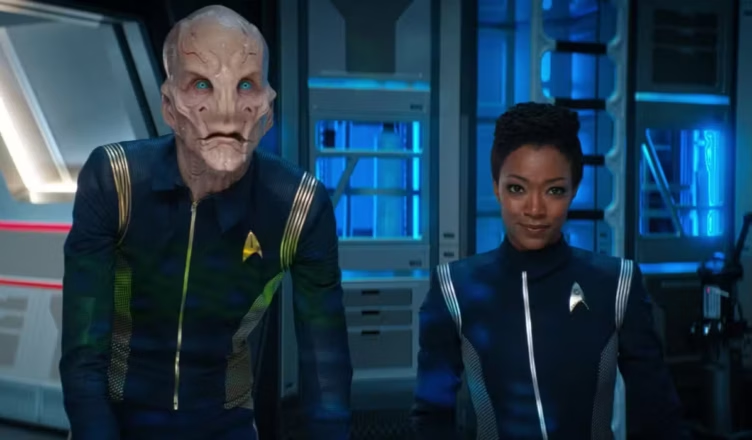
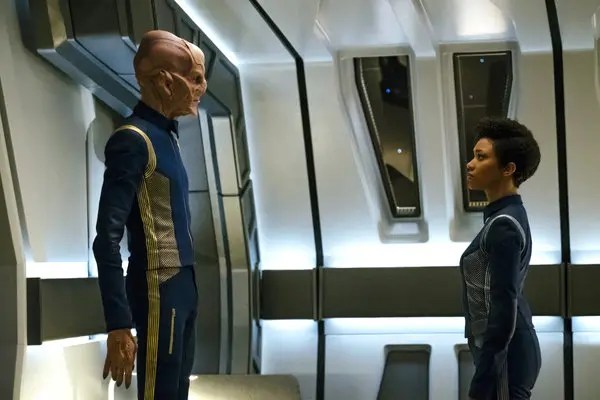
Michael Burnham and Saru began Star Trek: Discovery as rivals.
She was brilliant, impulsive and raised to suppress emotion through Vulcan discipline. He was cautious, observant and shaped by a Kelpien culture that taught him fear was essential to survival.
They challenged each other almost immediately.
But across five seasons, rivalry became respect, respect became trust, and trust became one of Discovery’s deepest relationships.
The USS Discovery could cross impossible distances through the mycelial network.
Burnham and Saru gave the ship its heart.
Their intertwined journeys unfolded across the official Star Trek: Discovery series, which followed the crew from the Klingon War into the distant future of the 32nd century.
Burnham and Saru Began on Opposite Sides of Command
Before the USS Discovery, there was the USS Shenzhou.
Captain Philippa Georgiou commanded both officers, but Burnham and Saru approached service very differently.
Burnham’s Vulcan upbringing taught her to trust knowledge, logic and decisive action. Saru’s threat ganglia made danger something he could physically sense, reinforcing instincts developed on a world where Kelpiens believed themselves to be prey.
Burnham often interpreted Saru’s caution as fear.
Saru could see Burnham’s certainty as recklessness.
Then came the Battle of the Binary Stars.
Georgiou died. The Shenzhou was lost. Burnham was convicted of mutiny, and Saru continued serving in the Starfleet she had disgraced herself trying to protect.
When they met again aboard Discovery, their history traveled with them.
Saru had every reason to distrust Burnham.
And Burnham had to live with the consequences of believing she alone knew what had to be done.
Their relationship couldn’t simply return to what it had been.
It had to become something new.
Fear and Failure Transformed Them Both
The brilliance of Michael Burnham and Saru is that neither character remained trapped inside the qualities that initially defined them.
Saru’s journey forced him to reconsider everything he understood about fear.
The Kelpiens had been taught that the predatory Ba’ul stood above them in the natural order and that reaching vahar’ai meant death. Saru eventually discovered that what his people understood as death was actually transformation.
He survived.
The threat ganglia that had defined his relationship with danger disappeared.
But Saru didn’t become courageous because he stopped experiencing fear.
He became courageous because fear no longer defined what he believed he was capable of becoming.
Burnham’s transformation moved in another direction.
Her failure taught her the limits of certainty.
She couldn’t logic her way out of grief. She couldn’t erase the consequences of the Klingon War. She couldn’t rebuild relationships merely by deciding she deserved forgiveness.
Burnham had to become more emotionally open precisely as Saru became less governed by fear.
Both were discovering identities larger than the ones their cultures had given them.
The Center Chair Tested Their Relationship
Eventually, command complicated everything.
Saru became captain of the USS Discovery after the ship traveled into the 32nd century. It was an extraordinary evolution for someone who had once believed his species existed to live beneath predators.
Burnham, however, had spent a year in that future before the rest of the crew arrived.
She had changed.
Her experiences with Cleveland Booker gave her an independence that didn’t always fit comfortably inside Saru’s chain of command. When Burnham believed action was necessary, the old instinct to move first and accept consequences later could resurface.
Their disagreements mattered because the relationship mattered.
Michael Burnham and Saru weren’t simply competing for authority.
They represented different approaches to leadership.
Saru valued stability, deliberation and responsibility for the entire crew.
Burnham trusted instinct, emotional connection and decisive action when conventional rules appeared inadequate.
Sometimes Saru was right.
Sometimes Burnham was.
The series became more interesting when neither position automatically won.
Their friendship had matured enough to survive the thing that once separated them most:
disagreement.

Burnham and Saru Became the Leaders They Saw in Each Other
When Burnham eventually became captain, the moment carried greater weight because Saru had traveled beside her for so much of the journey.
He remembered the officer aboard the Shenzhou.
He remembered the mutineer.
He remembered the woman trying to rebuild her life.
And he lived long enough to see her take the center chair.
Burnham had witnessed an equally extraordinary transformation.
The officer whose caution she once questioned became Captain Saru, a leader capable of guiding Discovery through displacement into a century where everyone aboard had lost the world they knew.
Their journeys therefore became mirrors.
Burnham learned that confidence wasn’t enough.
Saru learned that caution wasn’t destiny.
Burnham had to trust other people.
Saru had to trust himself.
And eventually each could recognize leadership in the other without diminishing their own.
That is what separated their relationship from a conventional command rivalry.
There didn’t have to be one winner.
The Heart of Discovery Was Trust
Star Trek: Discovery crossed centuries.
It fought a Klingon war, traveled through the Mirror Universe, encountered Control, jumped more than 900 years into the future and helped rebuild a fractured Federation.
Its technology became increasingly extraordinary.
But technology wasn’t what held the crew together.
Relationships did.
And Michael Burnham and Saru embodied that idea better than anyone.
They weren’t best friends from the beginning.
Their bond had to survive resentment, failure, command decisions, separation and profound personal change.
That made the relationship feel earned.
By the time Discovery reached the 32nd century, both characters had traveled much farther than the distance separating their original era from the future.
Burnham had moved from mutineer to captain.
Saru had moved from fear to command.
Neither journey happened alone.
That may be their most important contribution to Discovery.
Leadership wasn’t presented as something one extraordinary person possessed.
It could be strengthened through challenge.
Through disagreement.
Through forgiveness.
Through seeing potential in someone before they could completely see it themselves.
The spore drive allowed the USS Discovery to travel almost anywhere.
Michael Burnham and Saru showed why the people traveling together mattered more than the distance.
They began as rivals.
They became leaders.
And somewhere between those two points, they became the heart of Discovery.
Continue the Voyage
← Previous: Discovery: Rebuilding the Future
Explore the Hub: Star Trek 60 | Celebrating 60 Years of the Final Frontier
Upcoming → The Burn and Rebirth of the Federation | September 17
TheFilmGordon’s Star Trek 60 celebration continues throughout September with new stories exploring the voyages, captains, crews, starships, worlds, adversaries and ideas that have shaped the Final Frontier.
Discover more from FilmGordon
Subscribe to get the latest posts sent to your email.