by Tim Gordon
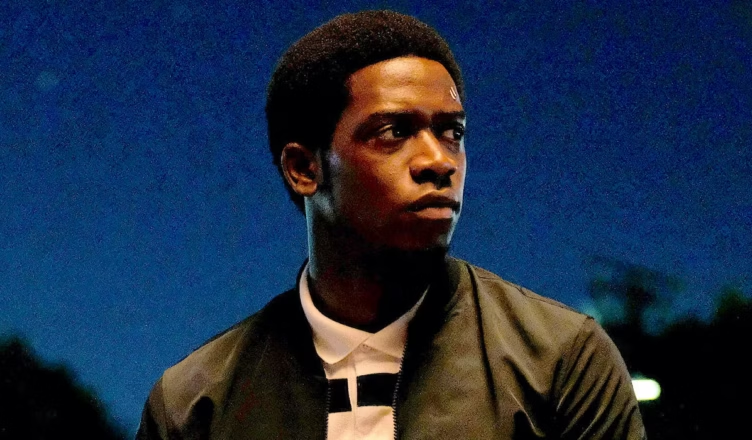
Franklin Saint Built an Empire to Escape His Neighborhood and Became Its Greatest Tragedy
When Snowfall introduces Franklin Saint, he isn’t a kingpin.
He isn’t carrying himself like a gangster. He isn’t dreaming about bodies, territory or becoming feared throughout Los Angeles. Franklin is intelligent, responsible and ambitious, a young man who understands that the opportunities available to him are painfully limited.
He wants more.
That distinction is essential to understanding one of television’s most devastating character arcs.
Franklin doesn’t enter the drug game because he wants to destroy his community. He enters because he sees money, independence and a way around an economic system he believes has already determined how far someone like him can go.
Then he becomes extraordinarily good at it.
Across six seasons of Snowfall, Franklin’s pursuit of financial freedom becomes an obsession with power. Friends become employees. Family becomes infrastructure. Loyalty becomes currency. Violence becomes strategy.
Eventually, Franklin possesses almost everything the young man from the pilot thought he wanted.
And loses nearly everything that once made getting it worthwhile.
Explore the complete Snowfall Universe.
Explore The Drop: A Snowfall Saga Series Hub.

Before the Empire, Franklin Saint Was a Neighborhood Kid
The Franklin of Snowfall’s pilot matters because the ending means considerably less if we forget who he was at the beginning.
Franklin is young, bright and capable of moving between different worlds. He has attended school outside his neighborhood and has enough exposure to wealth to understand that another version of life exists.
But he doesn’t possess an obvious path toward it.
His intelligence doesn’t automatically produce opportunity.
His work ethic doesn’t guarantee economic mobility.
And Franklin recognizes something that will drive almost every decision that follows: money creates choices.
At first, that’s what he wants.
Choices.
The tragedy is that Franklin eventually accumulates so much money that he begins believing money should eliminate consequences too.
It doesn’t.
Franklin Doesn’t Believe He’s Destroying His Community
Franklin’s earliest steps into the cocaine business aren’t driven by some grand plan to poison South Central Los Angeles.
They’re entrepreneurial.
He recognizes demand, learns distribution and begins constructing a network.
That distinction doesn’t absolve him of what follows. It makes what follows more disturbing.
Franklin can separate the business from its consequences because he initially sees himself as providing something people already want.
He’s making money.
He’s creating opportunities for people around him.
He’s building something.
But crack changes the equation.
The product becomes more destructive. Demand explodes. Money pours in. And the neighborhood Franklin believes he’s using to build his future increasingly becomes the raw material financing it.
The deeper Franklin travels into the business, the easier it becomes to measure success by what he’s accumulating rather than what everyone around him is losing.
Franklin Turns His Family Into an Organization
Franklin’s empire is never his alone.
That’s part of the tragedy.
He brings the people closest to him into the machine.
Jerome and Louie become essential to distribution. His mother, Cissy, eventually becomes involved in the financial and real-estate side of the operation. Leon grows from Franklin’s closest friend into one of his most important soldiers.
These relationships give Franklin something most criminal enterprises desperately need.
Trust.
But they also give the business access to everything he loves.
Once family and business become inseparable, every disagreement carries consequences beyond money.
A business dispute between Franklin and Louie isn’t merely a business dispute.
A conflict with Leon isn’t merely a personnel problem.
Jerome isn’t simply another distributor.
Cissy isn’t simply helping manage assets.
Franklin has turned his family tree into an organizational chart.
And eventually blood becomes both metaphorical and literal.
Teddy Makes Franklin Believe the Game Is Bigger Than the Streets
Franklin’s relationship with Teddy McDonald fundamentally changes his understanding of power.
The streets teach Franklin about territory.
Teddy teaches him about systems.
Franklin gradually discovers that the man supplying him isn’t merely another trafficker. His operation exists inside something much larger, connecting the cocaine flooding Los Angeles to covert American interests abroad.
That knowledge should make Franklin run.
Instead, it validates something he has increasingly come to believe.
Everybody is playing the game.
Governments. Intelligence agencies. Drug dealers. Banks. Politicians. Businessmen.
The difference is who gets protected while doing it.
Franklin begins seeing himself less as an aberration and more as another capitalist operating inside a system whose morality has always been negotiable.
But Teddy also teaches Franklin the cruelest lesson of all.
Being useful to powerful people doesn’t make you powerful.
It makes you useful.
Every Victory Costs Franklin Something
As Franklin’s empire expands, violence stops being an emergency measure and becomes part of doing business.
That’s where his transformation becomes unmistakable.
The young man who once wanted economic freedom becomes capable of making increasingly brutal calculations about anyone threatening what he has built.
Friends die.
Enemies die.
Innocent people suffer.
Relationships fracture.
The important question gradually stops being whether Franklin is capable of violence.
It’s whether there is anything he won’t sacrifice to preserve the empire.
Snowfall repeatedly answers by taking something else away.
Franklin survives physically, but each survival requires another piece of himself.
The frightening part isn’t that he suddenly becomes someone else.
It’s how incrementally it happens.
One compromise.
One justification.
One retaliation.
One body.
One more decision that would have horrified the Franklin Saint we originally met.
Leon Becomes the Mirror Franklin Doesn’t Want to See
Leon provides one of the series’ most important contrasts because he travels in the opposite direction.
Both men are shaped by the same streets.
Both participate in violence.
Both carry enormous guilt.
But eventually Leon begins asking whether survival requires becoming something different.
Franklin keeps asking how he can regain control.
That difference becomes increasingly important.
Leon begins searching for meaning beyond money and power. Franklin increasingly sees money and power as the only things capable of protecting him.
One man starts trying to find his way out spiritually.
The other keeps digging.
By the final season, their friendship carries the weight of everything they have survived together and everything they no longer understand about each other.
Franklin wants Leon’s money because Franklin believes money can still save him.
Leon understands that giving it to him may simply finance the next stage of his destruction.

Losing $73 Million Breaks Something Inside Franklin
Teddy’s theft of Franklin’s fortune transforms the final chapter of Snowfall.
Seventy-three million dollars isn’t simply money to Franklin.
It’s proof.
Proof that everything he did produced something.
Proof that the bodies, betrayals and compromises weren’t meaningless.
Proof that he beat the system.
When Teddy takes it, Franklin isn’t merely facing bankruptcy.
He’s confronting the possibility that everything he sacrificed may have been for nothing.
That is intolerable to him.
So Franklin becomes willing to sacrifice even more to recover it.
His relationships deteriorate. His desperation intensifies. The empire he spent years constructing begins collapsing around him while Franklin remains focused on restoring the number that, in his mind, validates his entire life.
At some point, Franklin stops fighting for freedom.
He’s fighting because he cannot accept losing.
Cissy Makes the Choice Franklin Cannot
The confrontation involving Teddy, Franklin and Cissy brings the entire tragedy into focus.
Franklin believes he’s finally close to recovering part of his fortune.
Cissy sees something else.
She sees what the pursuit has done to her son.
Her decision to kill Teddy destroys Franklin’s last realistic path toward recovering the money and effectively destroys their relationship.
Franklin cannot forgive her.
From his perspective, she takes away the future he has spent years fighting to secure.
From Cissy’s perspective, there may no longer be enough of her son left for the money to save.
That conflict is what makes the moment so devastating.
Both are looking at the same empire.
They simply disagree about what remains worth saving.
Franklin Finally Loses Control
The final collapse isn’t cinematic.
That’s precisely why it hurts.
Franklin doesn’t receive the glorious gangster ending audiences have been trained to expect. There is no throne, no final shootout that transforms him into legend, no grand reckoning that allows him to die at the height of his mythology.
Instead, things disappear.
The money.
The properties.
His relationship with Veronique.
His mother.
His influence.
His future.
Piece by piece, the machinery Franklin constructed to guarantee that nobody could ever control his life leaves him with almost nothing to control.
And Franklin turns increasingly toward alcohol.
The boy who believed money would give him freedom becomes a man unable to escape himself.
The Final Scene Brings Franklin Back Home
Then Snowfall delivers its cruelest image.
Leon finds Franklin wandering the neighborhood where everything began.
For six seasons, Franklin fought to escape the limitations represented by those streets.
Now he’s back.
But he isn’t the Franklin we met.
He’s physically diminished, emotionally detached and drinking heavily. The empire that once stretched across Los Angeles has vanished.
Leon offers help.
Franklin doesn’t want it.
And then comes the bitter irony.
Franklin tells Leon he’s finally free.
In one sense, he is.
Nobody can take his money because he has none.
Nobody can steal his empire because it’s gone.
Nobody can manipulate his ambition because the ambition has burned itself out.
The freedom Franklin spent his life chasing arrives only after there is almost nothing left.
Franklin Saint and the Shadow of Freeway Rick Ross
Franklin Saint is fictional, but his story draws inspiration from the history surrounding Los Angeles drug trafficker “Freeway” Rick Ross and the crack era that transformed the city.
Snowfall isn’t a biography of Ross. Instead, Franklin becomes a dramatic vehicle for examining a much larger ecosystem: street economics, addiction, government power and the devastation crack brought to Black communities.
That distinction matters.
Franklin represents the entrepreneur who believes he can understand the game well enough to control it.
By the end of Snowfall, he discovers something far more devastating.
The game has been controlling him.
Franklin Saint Is the Tragedy at the Heart of Snowfall
What makes Franklin Saint’s arc so devastating is that Snowfall never requires us to believe he began as a monster.
Quite the opposite.
We remember the kid.
We remember the intelligence.
The smile.
The ambition.
The belief that he could create something better.
That memory follows Franklin through every increasingly terrible decision.
He wanted to make money.
Then he needed to protect the money.
Then he needed power to protect the business producing the money.
Then he needed violence to protect the power.
Eventually, protecting the empire became more important than the people the empire was supposedly meant to help.
His family became casualties.
His friendships became transactional.
His community absorbed the devastation.
And Franklin gradually surrendered the parts of himself that once made his dream understandable.

Franklin Saint’s Shadow Hangs Over The Drop
Franklin Saint’s story ends with Snowfall, but the consequences of his empire don’t.
That’s where The Drop: A Snowfall Saga begins to take on greater meaning.
Wanda and Leon survived the world Franklin helped create. They watched crack transform their neighborhood, participated in the life surrounding Franklin’s organization and paid their own prices for surviving it.
Now it’s 1990.
The drug game hasn’t disappeared, but another economic and cultural force is exploding across Los Angeles.
Hip-hop.
For Wanda, music represents another opportunity to turn hustle into economic freedom. She recognizes talent in Artillery and Lamar and begins imagining the kind of future Franklin once imagined for himself.
That parallel should make anyone who watched Snowfall nervous.
Franklin also believed he could use the game without allowing the game to consume him.
The difference is that Wanda and Leon have already seen where that road can lead.
For Leon, that history is deeply personal.
Franklin wasn’t simply his closest connection to the old world. Franklin was his best friend.
Leon was there from the beginning, before the money, before the bodies and before Franklin became one of the most powerful drug dealers in Los Angeles. He helped build the empire, fought beside Franklin, challenged him, separated from him, reconciled with him and ultimately watched his best friend lose nearly everything they once believed they were fighting to achieve.
And Leon was there at the end.
When he finds Franklin wandering their old neighborhood in the Snowfall finale, Leon sees the complete cost of the journey they began together.
That gives Leon’s presence in The Drop enormous weight.
When he warns Wanda about the dangers surrounding Lamar, steps into the street politics threatening her music ambitions or questions whether his own work is actually changing anything, Leon isn’t speaking theoretically.
He watched his best friend build an empire.
And he watched that empire take his best friend away.
That makes Leon one of the most important bridges between Snowfall and The Drop. Wanda represents the possibility of a new hustle. Leon carries the memory of what happened the last time people they loved believed money could provide the way out.
Franklin doesn’t need to appear in The Drop for his presence to be felt.
Leon carries him into the new story.
Snowfall showed us the cost of building the empire.
The Drop is about the people who survived it trying to build something else.
Final Thoughts
The rise of Franklin Saint isn’t ultimately a story about how a young man became rich. It’s the foundation for understanding the world Wanda and Leon inherit in The Drop: A Snowfall Saga.
It’s about what he was willing to exchange for the possibility of never being powerless again.
That’s why the final scene of Snowfall remains so difficult to shake.
Franklin doesn’t simply lose.
He survives long enough to see what winning cost him.
The community-minded young man from the pilot wanted access to a world he believed had been denied to him. He found another route and discovered that he possessed the intelligence, discipline and ruthlessness necessary to build an empire.
But every expansion required another compromise.
Every threat required another response.
Every response made the next act easier to justify.
By the time Franklin recognized that the empire was disappearing, the money wasn’t simply his fortune anymore.
It was the only evidence he had left that the sacrifices meant something.
And when the money disappeared, there was nowhere left to hide from the cost.
That’s what makes Franklin Saint one of television’s most devastating portraits of the drug game.
Snowfall doesn’t end with its kingpin dead on a sidewalk or locked behind bars.
It does something crueler.
It takes him back to the neighborhood he spent six seasons trying to escape and leaves him there, alive enough to remember the empire, but too broken to reclaim the young man who built it.
Franklin Saint wanted money because he believed money meant freedom.
He got the money.
He got the power.
He got the empire.
And somewhere along the way, the price became Franklin Saint himself.
Discover more from FilmGordon
Subscribe to get the latest posts sent to your email.