
by Tim Gordon
From Borrowed Myth to Claimed Legacy
The gangster did not begin as a Black cinematic figure. He emerged in American film as a myth shaped by immigration, urban anxiety, and the promise of mobility in a system that offered uneven access. New York was his natural habitat. A city of iconic skylines and unforgiving streets, it gave the gangster something America promised but rarely guaranteed: opportunity without permission.
For decades, Hollywood defined the gangster through a narrow but powerful lens. From early sound-era films like The Public Enemy, Little Caesar, and the original Scarface to later landmarks such as The Godfather, Goodfellas, and Once Upon a Time in America, the genre established its grammar. Power as inheritance. Loyalty as currency. Violence as ritual. These stories did not invent crime. They mythologized it, transforming criminal enterprise into dynastic tragedy. Over time, that mythology hardened into template.
When Black gangsters finally moved to the center of the frame, they inherited a genre already fluent in power, but largely silent on race, exclusion, and systemic hostility.
What followed was not imitation. It was evolution.
The Foundation: Gangster as American Myth
Classic gangster cinema framed power as an alternate route into American legitimacy. The Corleones were criminals, but they were also businessmen, fathers, and stewards of order. Goodfellas stripped away romantic distance and immersed the audience in seduction itself. Belonging mattered more than morality. As long as you were inside, the rules bent.
These films assumed something critical: that power, once seized, carried meaning. Even if it didn’t last, simply reaching the top counted as arrival. The system acknowledged you before destroying you.
When race enters the equation, that assumption does not translate cleanly.
Bumpy Johnson: The Figure Hollywood Circled Before It Confronted
Before Black gangsters were centered onscreen, they existed largely on the margins of white narratives. No figure looms larger in that space than Ellsworth Raymond “Bumpy” Johnson.
Bumpy was not a mythic invention. He was real. A Harlem power broker whose influence stretched across decades, negotiating with and, at times, outmaneuvering white organized crime. His existence complicated the genre’s foundational assumptions. Power did not simply flow downward. It had to be contested, bargained for, and defended under constant pressure.
For years, Hollywood struggled with how to confront Bumpy’s legacy, and when it did, it did so cautiously. Early portrayals treated him as atmosphere rather than subject. His authority was felt, but rarely centered.
That changed in stages. The Cotton Club presented him as a commanding presence within a stylized Harlem ecosystem. Hoodlum later placed him unmistakably front and center, allowing Bumpy to exist as strategist, negotiator, and community power broker with full narrative authority. The film marked one of the first times mainstream cinema granted a Black gangster the same dramatic weight long afforded to white crime bosses.
American Gangster reframed Bumpy as legacy, positioning Frank Lucas as his inheritor rather than his anomaly. And Godfather of Harlem finally removed the remaining filters, placing Bumpy fully at the center of his own mythology.
Bumpy Johnson bridges borrowed mythology and lived reality. Without him, the evolution of the Black New York gangster onscreen does not fully come into focus.

Tommy Gibbs and the First Black Crown
That historical grounding becomes explicit with Black Caesar.
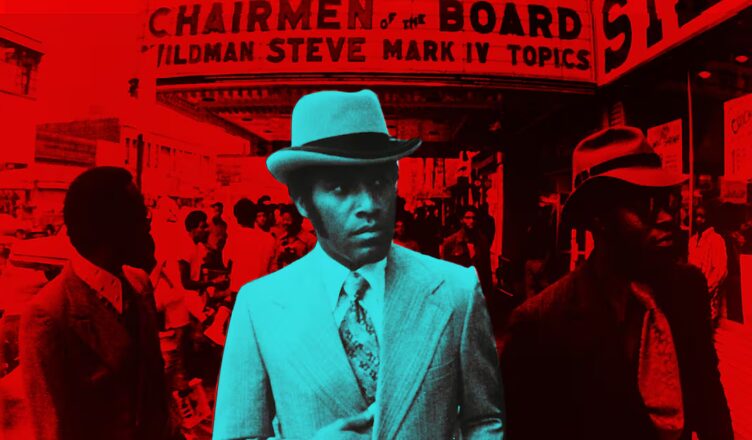
Portrayed by Fred Williamson, Tommy Gibbs stands as the first fully realized Black gangster protagonist in American cinema. Not a supporting threat. Not a cautionary footnote. A central figure whose rise, reign, and reckoning drive the narrative. This was not a Black character placed inside a white gangster myth. It was a reorientation of the myth itself.
Black Caesar roots Tommy’s ascent in brutality that is neither abstract nor symbolic. He is scarred early by police violence, marked by a system that treats Black bodies as disposable. His criminal trajectory does not begin with greed or ego. It begins with injury. Power is not indulgence. It is armor.
Where classical gangster films framed crime as rebellion against limitation, Black Caesar frames it as response to hostility. Tommy’s intelligence finds no sanctioned outlet. Criminal enterprise emerges as a parallel system shaped by exclusion. His violence is contextual, not ornamental. It carries memory. It carries grievance.
Williamson plays Tommy with pride sharpened by vigilance. Every gain feels provisional. Every alliance temporary. Power must be defended as aggressively as it is taken because it exists without institutional protection. There is no illusion of acceptance waiting at the top.
In doing so, Black Caesar establishes the governing logic of Black gangster cinema. Power is not romanticized as freedom. It is framed as leverage. Survival. Negotiation. A means of carving space inside a system designed to deny it.
Two decades later, New Jack City would update that survival logic for a crack-era New York, where power was no longer just seized to endure, but staged to dominate.
The Modern Evolution: From Survival to Spectacle
New Jack City doesn’t merely update the genre. It reprograms it.
Wesley Snipes’ Nino Brown emerges at the intersection of crack-era devastation and Reagan-era excess, fluent in both street logic and corporate rhetoric. This is the gangster as CEO. Boardrooms replace corners. Strategy replaces impulse. Image becomes currency. Nino doesn’t just want power. He wants recognition. Permanence.
What defines Nino is certainty. He treats power as infrastructure rather than illusion, believing scale provides immunity. New Jack City exposes the flaw in that logic. Nino’s downfall is not surprise. It is structural. The system he mirrors is designed to discard him.
Juice compresses that spectacle into something more volatile. Bishop, played by Tupac Shakur, is not seduced by wealth, but by control. Respect curdles into paranoia. Authority detaches from purpose. Bishop doesn’t build systems. He detonates them.
By the time Paid in Full arrives, Harlem hustle has crossed into full mythology. Rico, Mitch, and Ace chase legend rather than longevity. Visibility matters more than survival. Style outruns strategy. Momentum overwhelms caution.
The Black New York gangster has moved from survival-driven resistance into spectacle-driven dominance. Power is no longer claimed quietly as a means of survival, it is staged loudly to be seen.
Wesley Snipes and the Full Lifecycle of Power
What separates Wesley Snipes from every other actor in this lineage is not range. It is perspective.
He is the only performer to embody the Black New York gangster across three distinct phases of power.
In New Jack City, Nino Brown represents intoxication. Power at ignition. Confidence mistaken for permanence.
In Sugar Hill, Romello Skuggs represents burden. Inherited authority weighed down by legacy, responsibility, and fatigue. Escape replaces expansion.
In Brooklyn’s Finest, Caz represents aftermath. A former king released into irrelevance. The streets have moved on. Myth has expired. Power has no currency left.
This is not repetition. It is completion. Snipes allows the gangster to age, to calcify, and to survive his own mythology.


The Power Universe: When the Myth Becomes Infrastructure
By the time the Black New York gangster reaches this point of reckoning, the mythology no longer belongs to a single figure. It becomes generational. What Snipes mapped across three performances, the Power universe inherits as structure.
Overseen by Curtis “50 Cent Jackson, Power begins where earlier films often ended. James “Ghost” St. Patrick is introduced not as an aspirant, but as a man already fluent in authority. His struggle is not how to gain power, but how to outgrow it without being consumed by what he built.
As the universe expands, power circulates rather than settles. Children inherit unfinished wars. Loyalty fractures. Authority mutates. The gangster myth is no longer singular tragedy, but ecosystem.
His power is never owned, it is managed, inherited, and eventually surrendered.
Iconography and Echo: When the Gangster Leaves the Screen
The influence of the Black New York gangster does not stop at cinema. These figures escaped the screen and entered culture, language, and identity.
Hip-hop was the first inheritor. Rappers absorbed the visual and philosophical grammar of gangster cinema, adopting names and personas not to glorify crime, but to claim authorship. Mobsters and kingpins became symbolic stand-ins for power in a society that denied legitimate access to it.
Beyond music, gangster cinema shaped the self-mythologizing of real-world crime figures globally. Films did not teach crime. They gave it narrative. Structure. Aspiration.
The Black New York gangster transformed the echo by redefining power not as triumph, but as something perpetually negotiated, a distinction that carried global weight.
The Throughline
The Black New York gangster on film has never been fixed. From Tommy Gibbs claiming the first crown, through Bumpy Johnson negotiating power in plain sight, to Wesley Snipes aging the archetype across three lives, and finally into the generational infrastructure of Power, the story has always been about more than crime.
It is about access, systems that invite ambition but punish permanence.
These stories endure not because they celebrate outlaw behavior, but because they expose how power actually functions in America. It is unstable. It is conditional. And for those forced to take it rather than inherit it, the price is never abstract. It is personal, permanent, and paid in full.
Discover more from FilmGordon
Subscribe to get the latest posts sent to your email.


