

by Tim Gordon
Let’s Do It Again 1975 arrived in theaters fifty years ago, bringing audiences a vibrant blend of laughter, friendship, Black self-determination, and social consciousness wrapped inside a slick, streetwise caper. Directed by Sidney Poitier and starring Poitier alongside Bill Cosby, the comedy became one of the defining Black films of the decade.
Released on October 11, 1975, Let’s Do It Again also represented a major cultural moment. The film reunited Poitier and Cosby following Uptown Saturday Night while pairing Richard Wesley‘s screenplay with an unforgettable Curtis Mayfield soundtrack performed by The Staple Singers.
Half a century later, Let’s Do It Again remains more than a successful comedy. It stands at the intersection of Hollywood star power, Black creative control, community, friendship, and the soulful music that helped define an era.
Let’s Do It Again 1975 and the Poitier-Cosby Trilogy
While often grouped with Uptown Saturday Night and A Piece of the Action, Let’s Do It Again was not a traditional sequel. It was the second entry in a loose thematic trilogy pairing Poitier and Cosby in different roles and stories.
What connected the three films was not narrative continuity but a shared commitment to centering Black joy, friendship, ambition, and community in mainstream American cinema at a time when those images remained comparatively rare.
Following the success of Uptown Saturday Night, Poitier and Cosby returned as two ordinary men caught in extraordinary circumstances. Poitier plays Clyde Williams and Cosby portrays Billy Foster, members of the struggling Sons and Daughters of Shaka Lodge No. 2.
Released on October 11, 1975, the film not only marked a major cultural milestone but also reaffirmed the creative chemistry between Poitier and his frequent collaborator, Bill Cosby. Together, they gave audiences one of the defining comedies of the 1970s, a film that stood at the crossroads of Hollywood star power, Black self-determination, and the soulful soundtracks that defined an era.
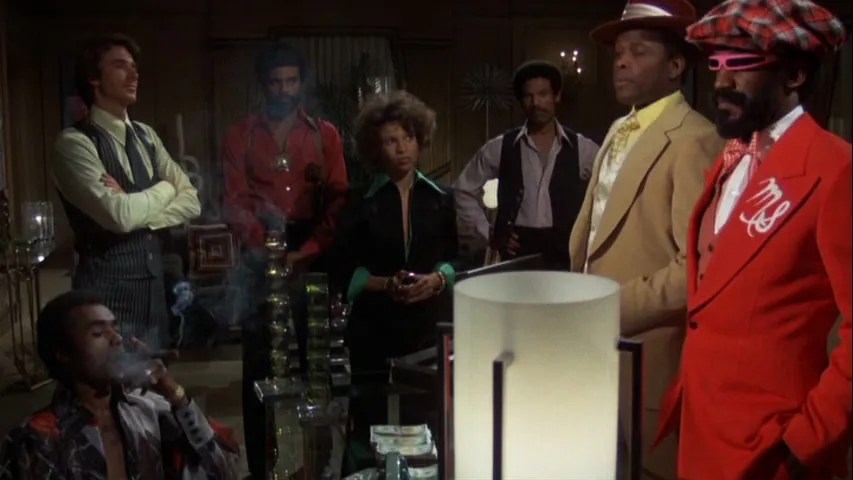
While often grouped with Uptown Saturday Night and A Piece of the Action, Let’s Do It Again was not a sequel. It was the second in a loose thematic trilogy that paired Poitier and Cosby in new roles each time. What connected these films was not story continuity, but a shared purpose to center Black joy, friendship, and ambition in mainstream American cinema at a time when such portrayals were still rare.
Following the success of Uptown Saturday Night, Poitier and Cosby returned to familiar ground as two ordinary men caught in extraordinary circumstances. Here, they play Clyde Williams (Poitier) and Billy Foster (Cosby), members of the struggling Sons and Daughters of Shaka Lodge No. 2. Facing financial ruin, they devise an audacious plan to hypnotize an unsuspecting boxer, Bootney Farnsworth (a young Jimmie “J.J.” Walker from Good Times), and fix a championship fight to save their lodge.
What might have been a simple farce becomes, under Poitier’s assured direction, a sly story about loyalty, community, and empowerment. The film’s warmth, humor, and moral grounding elevated it above typical comedies of its era, showing that Black filmmakers could produce stories that were both commercially successful and culturally resonant.
Curtis Mayfield Gives Let’s Do It Again Its Soul
The heartbeat of Let’s Do It Again belongs to Curtis Mayfield, whose unmistakable sound turned the film into a groove-driven experience. From the slinky basslines to The Staple Singers’ soaring harmonies, the soundtrack perfectly captured the era’s rhythm and optimism. The title track, “Let’s Do It Again,” became a massive crossover hit, reaching number one on both the Billboard R&B and Pop charts. Its success amplified the film’s visibility and proved that the union of Black film and Black music was creatively unstoppable.
Mayfield, already a master at blending social commentary with style through works like Super Fly and Claudine, transformed the movie’s lighthearted tone into a soulful reflection on unity and perseverance. The music gave the film its pulse, while Mavis Staples’ unforgettable voice gave it its heart.
Richard Wesley and the Black Life Behind the Comedy
Screenwriter Richard Wesley, who also penned Uptown Saturday Night, used Let’s Do It Again to expand his exploration of contemporary Black life with greater nuance and balance. An emerging playwright from Newark, Wesley had already made a name for himself with his award-winning 1971 stage play Black Terror, a searing political drama that captured the voice and urgency of the Black Power era. The play caught the attention of Poitier, who admired Wesley’s insight and hired him to write Uptown Saturday Night and later Let’s Do It Again. Wesley’s theatrical roots shine through in the film’s sharp dialogue, rhythmic pacing, and ensemble energy, all of which give the comedy a grounded authenticity that feels both lived-in and universal.
In interviews, Wesley shared that he wanted to improve upon Uptown Saturday Night by giving women stronger, more visible roles. In Let’s Do It Again, the wives and partners of Clyde and Billy are integral to the story’s resolution. They are grounded, loving, and essential to the men’s sense of purpose, reflecting the evolving dynamics of Black households in a decade that often celebrated independence over partnership.
Wesley’s approach stood apart from the solo heroines of the blaxploitation era, such as Pam Grier’s Coffy or Foxy Brown. Instead of focusing on lone warriors, he and Poitier crafted a story that celebrated collaboration between friends, spouses, and communities. This subtle shift helped broaden the emotional range of Black cinema, offering a vision of family and togetherness often missing from Hollywood’s depictions of Black life.
Black Self-Determination Behind Let’s Do It Again
Beneath its humor, Let’s Do It Again was a parable about self-reliance and determination. Clyde and Billy’s scheme was not just a hustle, but a metaphor for taking control of one’s destiny. The film’s themes echoed the messages of both Malcolm X and Martin Luther King Jr., emphasizing that salvation, whether economic or spiritual, begins with community-driven action. That spirit extended behind the camera. Poitier, one of the few Black directors working in Hollywood at the time, maintained creative authority over the project, ensuring that Black talent was centered not only on screen but throughout production. It was a quiet act of pride and perseverance that reinforced the film’s deeper message of empowerment.
What Let’s Do It Again Meant to Me
For me, Let’s Do It Again holds a personal significance that goes beyond its cinematic legacy. It was the first film I ever saw solo, marking the beginning of my lifelong journey as a film lover and critic. Even more meaningful, its writer, Wesley, and I share a hometown: Newark, New Jersey. That connection shaped how I experienced the film. Sitting in a Newark theater in 1975, watching a story written by someone who grew up walking the same blocks, seeing the same people, and dreaming of bigger things, was transformative. It proved that greatness could come from our neighborhoods and that our stories were worth telling.
Why Let’s Do It Again Still Matters 50 Years Later
Half a century later, Let’s Do It Again endures as a landmark of Black filmmaking, but it also invites more complicated reflection. Revisiting it today means acknowledging the complex legacy of Cosby, whose later controversies cast long shadows over his earlier work. It is possible to appreciate the historical and cultural importance of his collaborations with Poitier while still reckoning with the discomfort of hindsight.
It is also sobering to recognize how many of the film’s principal figures have since passed on, including Poitier, Mayfield, John Amos, and Calvin Lockhart, leaving behind a body of work that helped redefine Black artistic excellence. Their contributions live on not just in Let’s Do It Again, but in every filmmaker, musician, and storyteller inspired by their trailblazing spirit.
Fifty years later, Let’s Do It Again stands as both time capsule and torch, a celebration of friendship, faith, and the creative power of Black self-determination. Poitier’s direction, Wesley’s wit, Mayfield’s music, and Cosby’s then-undeniable charm combined to create a film that remains vibrant, soulful, and quintessentially of its time. For those of us who grew up in cities like Newark, it was more than a movie. It was a reflection of possibility, a reminder that we could laugh, love, and lift each other up while telling our own stories on our own terms.
Fifty years later, Let’s Do It Again still reminds us that joy itself can be an act of resistance and that some legacies, no matter how complex, remain vital to the evolution of our cinematic story.
Discover more from FilmGordon
Subscribe to get the latest posts sent to your email.


